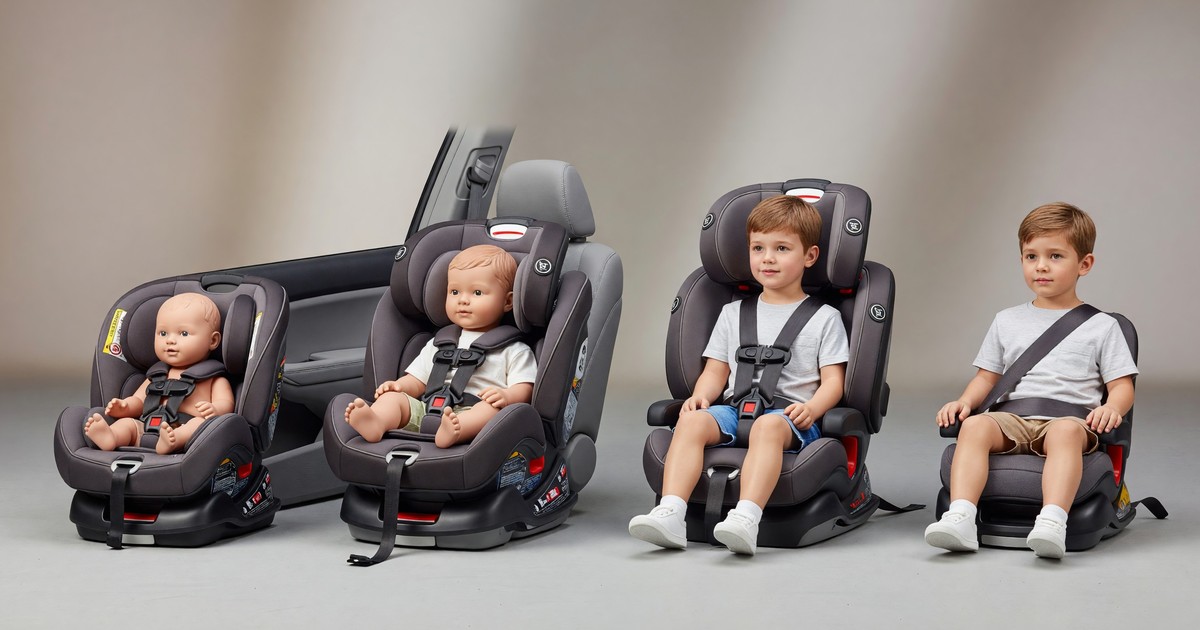
The morning you bring a newborn home from the hospital, a hospital staff member often comes to the parking lot to watch you install the car seat — or at least to confirm one is in the car. It is one of the few moments in the discharge process when someone other than you is paying close attention to whether the seat is actually in there correctly. After that, you are on your own.
Car seats save lives. The National Highway Traffic Safety Administration estimates that car seats reduce the risk of injury by 71–82 percent for infants and toddlers in crashes. The problem is that NHTSA’s own studies have found that roughly 46 percent of car seats are used or installed incorrectly. The errors are not dramatic — harness too loose, chest clip at the wrong height, seat installed at the wrong angle — but they matter in a crash.
This guide covers what to look for, how to check your installation, and the transitions parents most often get wrong.
Which seat for which age and size
Car seat guidance from the American Academy of Pediatrics and NHTSA is weight-and-height based, not strictly age based. A larger baby may move through stages faster; a smaller or premature baby may stay in each stage longer. Always follow the seat manufacturer’s limits first, then apply the general guidelines.
Infant-only bucket seats are designed for the earliest stage — typically up to 35 pounds or the seat’s height limit, whichever comes first. They are rear-facing only, which is the correct orientation for newborns and all infants. They snap into a base that stays in the car, which makes it easier to move a sleeping baby without disrupting the installation.
Convertible seats can be used rear-facing for infants and young toddlers, then flipped to forward-facing as the child grows. They stay in the car — there is no removable carrier. They tend to have higher weight limits than infant-only seats, so many families use them from birth and skip the bucket seat entirely.
All-in-one seats are the longest-lasting option — rear-facing, forward-facing with a harness, and eventually booster mode with a seat belt. If you are buying one seat and done, this is it, though they are typically heavier and bulkier.
Current AAP guidance recommends keeping children rear-facing as long as possible — until they reach the maximum weight or height for the rear-facing position in their specific seat. Car seat safety is one component of the broader infant safety foundation — our infant first aid essentials guide covers the other preparation parents should do before an emergency occurs. The previous AAP guidance (age 2 as a milestone) has been updated: the seat’s limits determine the transition, not a specific birthday.
Rear-facing: the most critical period
The rear-facing position is the safest orientation for infants and young children in a crash because it distributes crash forces across the whole back, neck, and head rather than concentrating them on the neck and spine. This matters most in the age group most vulnerable to spinal injury.
A rear-facing seat should be:
- Angled correctly. Most seats have a level indicator — a bubble gauge or a marked line — that shows the correct recline angle. Newborns need a more reclined angle (about 45 degrees) so their heads do not fall forward and restrict their airway. As children grow, the seat can be more upright. If your seat’s level indicator is showing incorrectly in your vehicle, use the rolled tightly pool-noodle or foam wedge methods specified in your seat’s manual to correct the angle.
- Installed tightly. Grip the seat at the base and shake it front-to-back and side-to-side. It should not move more than one inch in any direction.
- Secured with either LATCH or seat belt, not both. LATCH (the lower anchors in the seat cushion crease) and the vehicle seat belt are equivalent safety systems when used correctly. Using both simultaneously can actually overload the lower anchors in some vehicles. Check your vehicle owner’s manual for the weight limit of your LATCH system — many cap at 65 pounds combined (child plus seat weight).
Harness fit: the check most parents miss
A correctly installed seat is useless with a poorly fitted harness. The harness needs to pass two checks:
The pinch test. With the harness buckled, try to pinch the harness webbing at the shoulder. If you can pinch any material, the harness is too loose. Tighten the harness until you cannot gather any slack.
The chest clip position. The chest clip belongs at armpit level — level with the armpits, not on the belly. Too low and it can cause abdominal injuries in a crash; too high and it can restrict breathing if the child slumps. Check it every single ride.
Bulky coats and car seats do not mix. A puffy winter coat compresses in a crash, leaving up to several inches of slack in the harness that was not there when you buckled in. The AAP and Safe Kids Worldwide both recommend buckling the child without the coat, then placing the coat over the top of the buckled harness like a blanket, or using a car-seat-safe fleece that goes under the harness.
Getting a professional check
Even parents who read every manual miss things. NHTSA operates a network of trained child passenger safety technicians (CPSTs) who provide free car seat checks. You can find a check event or inspection station near you at nhtsa.gov/car-seat-inspection-station. These are often hosted at fire stations, hospitals, and AAA locations.
Safe Kids Worldwide also maintains a check-event finder at safekids.org. A 15-minute inspection from a CPST has caught installation errors that parents had been making for months without knowing. It is worth the trip.
The forward-facing transition
Moving a child to forward-facing before they are at the rear-facing limit of their seat offers no benefit and reduces protection. When they do reach that limit:
- The seat must be forward-facing with a 5-point harness.
- The harness stays in use until the child exceeds the forward-facing harness limit (often 65 pounds, though some seats go higher).
- Forward-facing seats require the top tether — a strap that connects the top of the seat to an anchor point in the vehicle — to be secured. This is the step most often skipped. The top tether significantly reduces head excursion in a crash. It is never optional in forward-facing mode.
The booster transition and beyond
When a child exceeds the weight or height limit for the forward-facing harness, they move to a belt-positioning booster. The booster positions the vehicle seat belt correctly across the child’s chest and hips — it does not have its own harness. Children need a booster until the seat belt fits without it: lap belt flat across the upper thighs (not the belly), shoulder belt crossing the center of the chest and shoulder (not the neck or off the shoulder), and the child able to sit with their back flat against the vehicle seat with feet flat on the floor.
Most children are not ready for a seat belt alone until they are at least 4 feet 9 inches tall — typically between ages 8 and 12. Using a booster until that fit is correct is safer than rushing the transition.
What to do with a used seat
Car seats have expiration dates — typically 6 to 10 years from manufacture, printed on a label on the seat. An expired seat’s plastic may have degraded and its crash performance is unknown.
Used seats are only safe if you know the full history: no crashes, stored properly (not in an extreme-heat garage for years), all parts intact, and within the expiration date. If you cannot confirm all of those things, a used seat from an unknown source is not worth the risk. Many retailers offer trade-in events where old seats can be exchanged for discounts.
A seat involved in a crash — even a minor one — should generally be replaced. NHTSA’s guidance distinguishes between minor and moderate/severe crashes and provides criteria for when a seat that was in a minor crash may be reused, but the threshold for “minor” is narrow. When in doubt, replace.
Frequently Asked Questions
When can my baby face forward? Your child can move to forward-facing when they have outgrown the rear-facing weight or height limit of their specific seat — not at any particular age. The AAP removed the age-2 guideline in 2018 and now says: keep children rear-facing as long as the seat allows. Always check the label on your specific seat for its limits.
How tight should the harness be? Tight enough that you cannot pinch any slack in the harness webbing at the shoulder. This is called the pinch test. You should also be able to fit no more than two fingers under the harness at the collarbone. Check this every time you buckle in — it is the most common error.
Can I use a car seat that was in an accident? NHTSA guidance says a seat should be replaced after any moderate or severe crash. For minor crashes (low speed, vehicle drivable, no visible damage, no airbag deployment, no injuries), NHTSA criteria allow reuse, but the standard of care among child passenger safety technicians is to replace after any crash if you can afford to do so. If you are not certain what category a crash falls into, replace the seat.
Do car seats expire? Yes. Expiration dates are printed on a label on the seat — typically 6 to 10 years from the manufacture date. After expiration, the plastic composition and structural integrity cannot be guaranteed to meet crash standards.
Is it safe to buy a used car seat? Only if you can fully verify the seat’s history: no crashes, no missing parts, no modifications, storage in moderate temperatures, and within the expiration date. If you cannot verify all of this, purchase new. Many communities have programs that provide free or reduced-cost car seats for families who need them — your local WIC office or pediatrician’s office may know of local resources.
Does the top tether really matter for forward-facing seats? Yes. The top tether is not optional — it is a required component of correct forward-facing installation. NHTSA testing has shown the top tether can reduce a child’s head movement in a crash by up to 6 inches, significantly reducing the risk of head injury. The anchor point is in the vehicle — check your owner’s manual for its location.
Further Reading from Authoritative Sources
- NHTSA Car Seats and Booster Seats — Federal agency guidance on seat types, installation, and how to find a free inspection near you.
- AAP Car Seat Safety Recommendations — HealthyChildren.org — The American Academy of Pediatrics’ full guidance on rear-facing, forward-facing, and booster transitions, updated for current best practices.