The time to learn infant CPR is not when your baby stops breathing. The time to figure out whether there is a poison control number on your phone is not when your toddler has gotten into the cabinet under the bathroom sink. First aid knowledge is the kind of thing that feels urgent to get around to and then does not happen until something goes wrong.
This guide covers the infant first aid situations most parents will actually encounter — choking, breathing emergencies, fever management, minor wounds — along with what a reasonable home kit contains and where to get hands-on training. Reading this article is not the same as training, and for CPR and choking rescue in particular, there is no substitute for hands-on practice with a certified instructor. Consider this the starting framework, not the complete preparation.
The first rule: know when to call 911 first
Some situations require calling 911 before anything else. In these scenarios, dispatchers can walk you through what to do while help is on the way:
- A baby who is unresponsive and cannot be woken
- A baby who stops breathing or whose lips or skin turn blue
- A baby who is choking and cannot clear the obstruction in the first few back blows and chest thrusts
- A seizure of any duration in an infant
- Suspected poisoning in an infant who is unresponsive or having difficulty breathing
When you call 911, stay on the line. The dispatcher will give you real-time instruction tailored to what you are seeing. In a true emergency, following dispatcher instructions while waiting for help is almost always the right call.
For non-emergency poisoning situations — a child who has ingested something and is alert and not in distress — call Poison Control at 1-800-222-1222. This line is staffed 24/7 by toxicologists who can tell you exactly how serious the exposure is and what to do. Having this number in your contacts before you need it is one of the most practical pieces of emergency prep for any household with young children.
Infant choking: back blows and chest thrusts
Choking is one of the leading causes of injury-related death in children under age 4, according to the CDC’s injury prevention data. Infants are particularly at risk because of the combination of mouthing behavior, an airway diameter smaller than a finger, and poor coordination of swallowing.
Signs of choking: sudden inability to cry or cough, high-pitched noise or no noise at all, a bluish tinge to the skin, face, or lips, ineffective coughing, or panicked distress.
If the baby can cough forcefully or cry, encourage coughing and do not intervene — an effective cough is more powerful than any intervention. If coughing is weak, there is no sound, or the baby cannot breathe effectively:
For infants under 1 year (5 back blows + 5 chest thrusts — alternate):
- Hold the baby face-down along your forearm, supporting the head. The head should be lower than the chest.
- Give 5 firm back blows with the heel of your hand, between the shoulder blades.
- Flip the baby face-up, still supporting the head. Give 5 chest thrusts — two fingers pressed down on the center of the chest, about 1.5 inches deep.
- Alternate 5 back blows and 5 chest thrusts until the object is cleared or the baby loses consciousness.
- If the baby loses consciousness, begin infant CPR and call 911 if not already done.
Do not use abdominal thrusts (the Heimlich maneuver) in infants under 1 year — the Heimlich is for children over 1 year and adults.
The American Red Cross provides illustrated choking rescue guides and offers infant first aid courses in most communities.
Infant CPR: the basics
Infant CPR is different from adult CPR in technique and rate. The steps:
- Check for responsiveness. Flick the bottom of the foot or tap the shoulder. If no response, call 911.
- Open the airway. Tilt the head back gently — in an infant, a neutral position (not tilted back as far as in an adult).
- Check for breathing. Look, listen, and feel for breath for no more than 10 seconds. If no breathing, begin CPR.
- Give 2 rescue breaths. Cover both the infant’s mouth and nose with your mouth. Give two gentle puffs — just enough to see the chest rise. Do not blow hard.
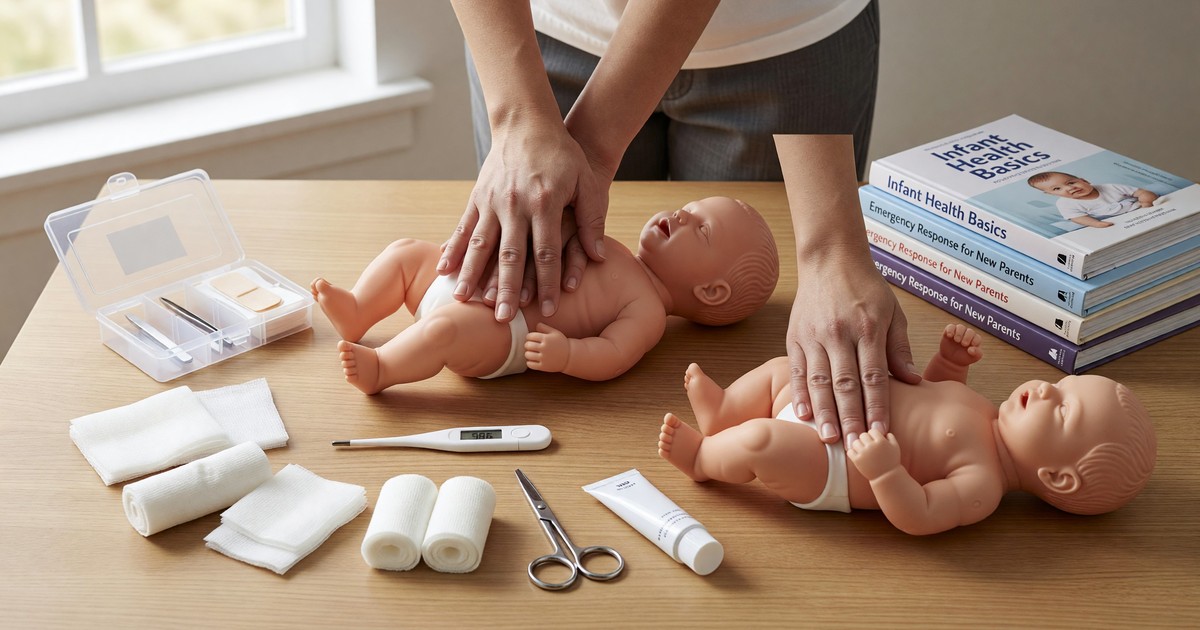
- 30 chest compressions. Use two fingers in the center of the chest, just below the nipple line. Compress about 1.5 inches deep at a rate of 100–120 compressions per minute. The “Stayin’ Alive” rhythm by the Bee Gees is approximately the right pace.
- Repeat. 30 compressions, 2 breaths, repeat until help arrives or the baby breathes independently.
An AED (automated external defibrillator) can be used in infants — use pediatric pads if available. If only adult pads are available, place one pad on the front of the chest and one on the back.
Get trained. The American Heart Association and the American Red Cross both offer infant and child CPR courses. Many hospitals offer free or low-cost courses for new parents. The muscle memory from hands-on practice matters — reading instructions in an emergency is not the same as having done it.
Fever management in infants
Fever guidelines for infants are age-dependent. The thresholds that require immediate medical evaluation:
- Any fever in an infant under 3 months (rectal temperature of 100.4°F / 38°C or higher) — go to the ER. Do not wait for a pediatrician callback.
- Fever above 104°F (40°C) in any infant — call the pediatrician immediately.
- Fever in a 3–6 month infant above 102°F (38.9°C) — call the pediatrician.
Measuring temperature correctly: For infants under 3 months, rectal temperature is the most accurate method. Ear thermometers and forehead thermometers have more variability in small infants. Axillary (armpit) temperature runs approximately 1°F lower than core temperature.
Fever reducers: Acetaminophen (Tylenol) is appropriate for infants 2 months and older. Ibuprofen is not recommended before 6 months. Aspirin should never be given to children. Dose by weight, not age — the bottle’s dosing chart uses age, but pediatricians dose by weight for accuracy. Confirm the correct dose for your infant’s current weight at every visit. The AAP’s fever guidance at HealthyChildren.org covers both measurement technique and dosing principles.
Tepid (not cold) sponge baths can help a child feel more comfortable but do not bring fever down significantly. Do not use rubbing alcohol or ice.
Minor wound and skin care
Cuts and scrapes: Clean with cool running water for 1–2 minutes. Apply gentle pressure with a clean cloth to stop bleeding. Small wounds can be covered with a bandage; large or deep wounds that gape open or do not stop bleeding in 10–15 minutes of steady pressure should be seen in an urgent care or ER.
Burns: Cool the burn immediately with cool (not cold, not ice) running water for 10 minutes. Do not use butter, oil, or toothpaste. Cover loosely with a non-stick sterile dressing. Any burn on an infant, any burn to the face, hands, feet, or genitals, or any burn larger than a coin should be evaluated in the ER. Blisters should not be popped.
Suspected poisoning or chemical exposure: For skin or eye contact with a chemical, flush with large amounts of water for 15 minutes. Call Poison Control (1-800-222-1222) for guidance on what to watch for and whether to go to the ER. Do not induce vomiting unless Poison Control specifically tells you to.
Insect stings: For a bee or wasp sting, scrape out the stinger (do not pinch — that injects more venom). Apply a cold compress. Watch for signs of allergic reaction: hives beyond the sting site, facial swelling, difficulty breathing, unusual fussiness or limpness. Any signs of allergic reaction are a 911 call.
What belongs in an infant first aid kit
A reasonable home kit for a household with an infant:
- Rectal thermometer (most accurate for infants under 3 months)
- Infant acetaminophen in the correct dose for your infant’s current weight
- Saline nasal drops and bulb syringe or NoseFrida
- Bandages in assorted sizes, including non-stick pads for larger wounds
- Medical tape
- Antiseptic wipes or wound-cleaning solution
- A small pair of blunt-tip scissors and tweezers
- Cooling gel pads (for minor burns)
- A digital copy of your infant’s pediatrician contact information and nearest ER address
- Poison Control number (1-800-222-1222) in your phone contacts
No kit replaces the judgment call of when to use it versus when to go in. When in doubt about severity, call your pediatrician’s nurse line. See our guide to urgent care vs ER for an infant for a framework on that decision.
Frequently Asked Questions
How do I know if my baby is choking versus gagging? Gagging involves coughing, retching, and often crying — the airway is partially clear and the baby can make sounds. Choking is typically silent or nearly silent, with an inability to cry or cough effectively, possible blue tinge to lips or skin, and a look of distress without noise. If the baby can cry or cough forcefully, let them work it out. If they cannot, begin the back blows and chest thrusts sequence.
When should I give my baby Tylenol for a fever? Fever reducers treat discomfort, not the fever itself. A fever with a comfortable, alert, hydrated infant may not require treatment. The thresholds for requiring immediate evaluation are: any fever in an infant under 3 months, fever above 104°F at any age, and fever above 102°F in a 3–6 month infant. Always dose acetaminophen by your infant’s current weight, not the label’s age range.
What is the Poison Control number? 1-800-222-1222 in the United States. This connects directly to your regional Poison Control Center, staffed 24/7 by toxicologists. Save it in your phone now, before you need it.
How do I do infant CPR if I am alone? Call 911 first — even if it means putting the phone on speaker and setting it down. Dispatcher-guided CPR is as effective as untrained CPR and often better. Begin CPR immediately while on the phone. If you have trained in CPR, the dispatcher will confirm your technique. If you have not, the dispatcher will walk you through it.
Should I take an infant CPR class? Yes. The American Heart Association and the American Red Cross both offer in-person infant CPR classes, many of which are free or low-cost at hospitals and fire stations. The hands-on component — actually practicing compressions and rescue breaths on a mannequin — is what builds the muscle memory that functions under stress. Reading instructions is not a substitute.
Further Reading from Authoritative Sources
- CDC Choking Prevention and First Aid Guidance — The CDC’s data on choking as a leading cause of injury-related death in young children, with prevention strategies.
- AAP First Aid Information — HealthyChildren.org — The American Academy of Pediatrics’ parent-facing first aid guidance organized by type of emergency, including fever, wounds, choking, and poisoning.