Every year in the United States, dozens of children die of heatstroke after being left in a vehicle, and the youngest children carry the greatest risk. The National Highway Traffic Safety Administration reports that an average of 37 children under age 15 die this way each year. In 2024 the toll was 39 children, up from 29 the year before, according to NHTSA and the National Safety Council. These are not distant statistics. They are, overwhelmingly, ordinary families on ordinary days.
The hardest fact for many parents to accept is who this happens to. In the majority of cases, the child was unknowingly left behind by a loving, attentive parent or caregiver. It is not a story about negligence. It is a story about how memory works under stress, how quickly a car becomes dangerous, and how a few deliberate habits can close the gap.
Why infants are the most vulnerable
A child’s body is not a smaller version of an adult’s when it comes to handling heat. According to NHTSA, a child’s body temperature rises three to five times faster than an adult’s. Heatstroke sets in when core body temperature reaches roughly 104°F, and it can become fatal at around 107°F.
Several physiological realities drive that faster rise. Young children have more body surface area relative to their mass, so they absorb heat from their surroundings more quickly. Their sweating and heat-dissipation systems are less developed, so they shed heat more slowly than an adult would. And because a larger share of a young child’s body weight is water, dehydration compounds quickly. Infants add another layer of risk: strapped into a rear-facing car seat, an infant cannot move away from a sun-warmed surface, cannot loosen clothing, and cannot call for help.
The age data reflects this vulnerability. Kids and Car Safety, which tracks these cases, reports that 86 percent of children who die in hot cars are age 3 and younger, and more than half are under age 2. The victims have ranged in age from as young as five days old.
How fast a parked car becomes deadly
The danger is a matter of minutes, not hours, and it does not require a scorching day. A parked car behaves like a greenhouse: sunlight passes through the glass, heats the interior surfaces, and that heat has nowhere to escape.
The National Weather Service documents just how fast this happens:
- The temperature inside a vehicle can climb about 20 degrees in the first 10 minutes.
- It can rise roughly 50 degrees in an hour, even when the outside temperature is only in the 70s.
- Interior temperatures can reach 120°F or higher, well into the range that causes fatal heatstroke in a small child.
Two common assumptions make this worse. The first is that cracking the windows helps. The National Weather Service notes that a partially opened window does not meaningfully slow the heating. The second is that a mild day is a safe day. Children have died of vehicular heatstroke on days when the outside temperature was in the 70s. There is no outdoor temperature at which a parked car is safe for an infant.
It happens to careful parents
Because the instinct is to assume this could never happen to us, it helps to understand the mechanics. Research compiled by NHTSA and Kids and Car Safety indicates that in more than half of these deaths, the child was forgotten by a parent or caregiver. Roughly 45 percent of the children who were unknowingly left had been supposed to be dropped off at childcare — a break in the normal routine, a change of driver, a skipped daycare stop.
Memory researchers describe this as a failure of prospective memory, the brain’s system for remembering to do a planned task in the future. When a routine is disrupted, when a driver is sleep-deprived or stressed, or when a quiet infant makes no sound from the back seat, the brain’s “autopilot” can complete the familiar drive to work while the plan to stop at daycare silently drops out of awareness. It is a documented failure that has happened to teachers, nurses, and even a pediatrician. Believing “I would never forget my child” is itself part of the risk, because it discourages parents from building the safeguards that catch the lapse.
A separate category of cases involves children who were not left by an adult at all, but who climbed into an unlocked car on their own and could not get out. This is why safety agencies urge families to keep vehicles locked and keys out of children’s reach even when no one is driving anywhere.
“Look Before You Lock”: the habit that prevents it
NHTSA’s national campaign, “Where’s Baby? Look Before You Lock,” is built around a simple idea: do not rely on memory alone. Build a physical system that forces a check of the back seat every single time. The agency’s core reminder is “Stop. Look. Lock.” — before you walk away, stop, open the back door, and confirm the seat is empty.
Practical habits that safety agencies recommend:
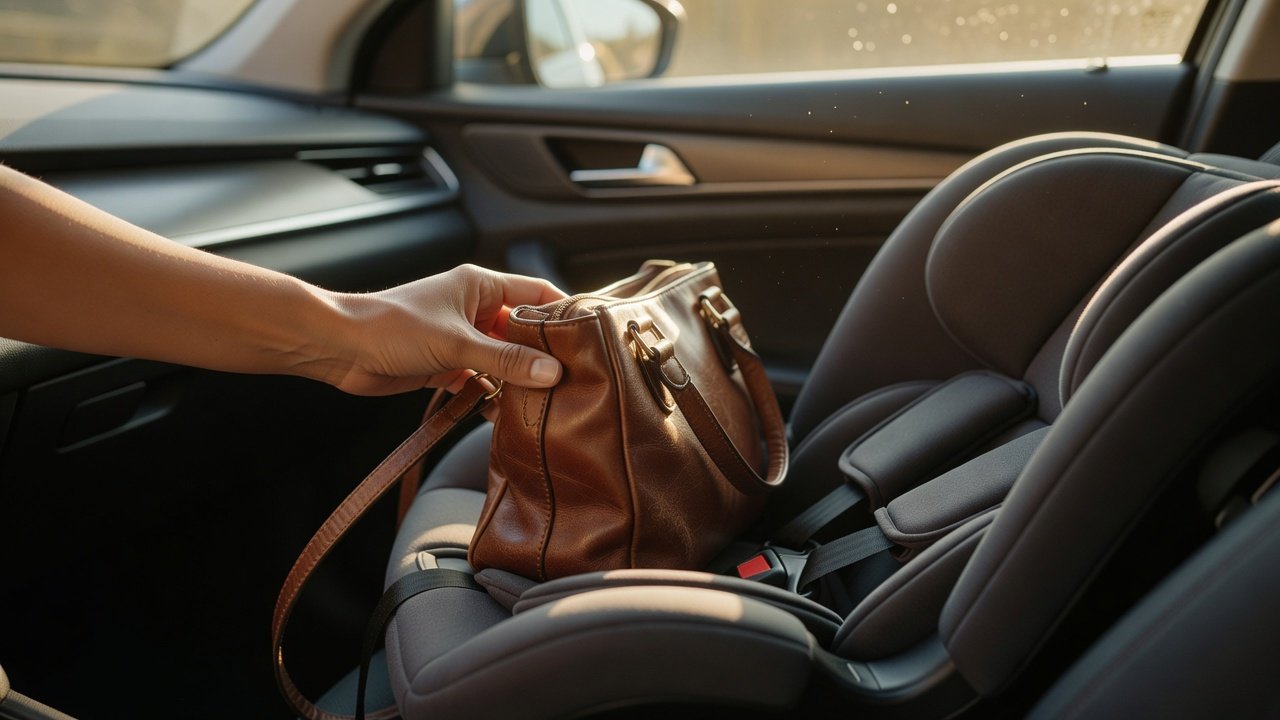
- Put something you need in the back seat. Place your phone, purse, work badge, or left shoe next to the car seat. You cannot start your day without it, so retrieving it forces you to open the back door and look.
- Use a visual cue up front. Keep a stuffed animal in the empty car seat, and move it to the front passenger seat whenever the child is in the seat. A toy riding shotgun is a signal that a child is in the back.
- Set up a daycare check-in. Ask your childcare provider to call you within a set window if your child has not arrived as expected — and to actually make that call. A missed drop-off should trigger a phone call, not a note.
- Keep the car locked and keys away. Prevent children from climbing into a parked vehicle by locking doors and trunks and storing keys and fobs where a child cannot reach them.
- Never leave a child alone in a car, even for a minute. Not while you run into a store, not while the car is running with the air conditioning on, not on a cool day.
If you ever see a child alone in a vehicle and in distress, NHTSA’s guidance is direct: ACT. Call 911 immediately. Emergency personnel are trained to respond, and many states have laws protecting bystanders who intervene to reach a child in danger.
Technology helps, but is not yet a guarantee
Some newer vehicles include rear-seat reminder systems that prompt the driver to check the back seat at the end of a trip, typically triggered when a rear door was opened before the drive began. Under a provision of the 2021 federal infrastructure law — often called the Hot Cars Act — Congress directed NHTSA to require such detection-and-alert systems in new passenger vehicles. As of 2025, that rulemaking remained behind its original schedule, so coverage across the vehicle fleet is still uneven.
Aftermarket devices and smartphone apps that pair with a car seat can also serve as a backup. But every safety agency frames technology as a supplement, not a substitute. The reminders that reliably work today are the low-tech, deliberate habits a family builds and repeats until they are automatic.
The prevention that matters is the one you set up before a hot day arrives: put something you cannot leave behind in the back seat, move the toy to the front when your child is buckled in, keep the car locked, and open that back door to look every time you park. Make the check a reflex, not a decision — because on the day it matters, the decision is exactly what a tired, distracted brain forgets to make.
This article is for general educational purposes and is not medical advice. For emergencies, call 911. For guidance specific to your family, consult a qualified healthcare or child-safety professional.