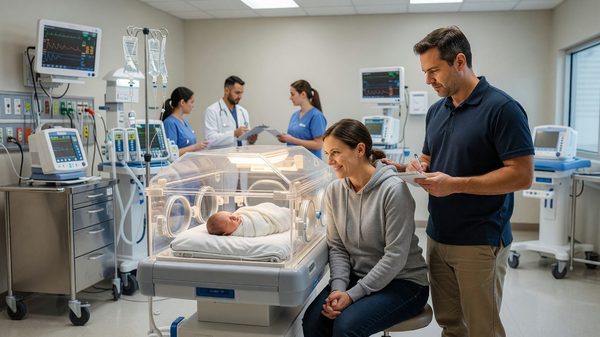
You’re three days into a hospital stay with your child, the bill is starting to feel real, the discharge nurse mentioned “follow-up” and “home health” and a list of words you didn’t fully catch, and someone has handed you a Medicaid application that might as well be in a foreign language. You ask the bedside nurse what to do, and she says, almost in passing, “you should talk to social work.”
So you nod. And then nothing happens. Because nobody told you a social worker existed for your situation, nobody told you how to reach one, and nobody explained what they actually do.
This is one of the most common gaps we see in hospital stays. Below is what we’ve learned from parents who eventually figured this out — what hospital social workers do, how to ask for one, and what to bring to the conversation.
What hospital social workers actually do
The phrase “social worker” carries a lot of associations, most of which don’t match what hospital social workers are doing day to day. In a hospital setting, the job is essentially logistics, advocacy, and connecting families to resources. Some of what’s in scope:
- Discharge planning. What does going home look like? Do you need home nursing, durable medical equipment, a feeding pump, oxygen? Who orders that? How does it get to your house? The social worker (often in tandem with a case manager) coordinates this.
- Financial assistance. Most hospitals have a charity care or financial assistance policy. The social worker can hand you the application, explain what counts as income, and route it through faster than you can on your own.
- Insurance navigation. Helping you understand what’s covered, what isn’t, and what to appeal. They can also help with Medicaid and CHIP applications — see Medicaid.gov for the federal overview and our state-by-state Medicaid guide for application paths.
- Connection to community resources. Food banks, transportation, lodging near the hospital, parent support groups, mental health referrals.
- Advocacy within the team. If communication has broken down, if you’re not getting answers, if you feel rushed at discharge — a social worker can intervene and convene a meeting.
- Practical paperwork. FMLA paperwork for your employer, short-term disability, school notes, custody documents in complex family situations.
- Crisis support. Sudden diagnosis, traumatic event, suspected abuse or neglect concerns, domestic violence. They are often the first line.
What hospital social workers are not, in most cases:
- Therapists. They can refer you to one. They typically aren’t seeing you for ongoing counseling.
- Long-term case managers. Their role usually ends at discharge unless your hospital has a specific outpatient program.
- Lawyers. They can connect you with legal aid but they don’t give legal advice.
The role is heavily focused on the hospital stay itself and the transition home.
How to ask for one (it’s not always automatic)
Here’s the thing most parents don’t know: you usually have to ask. Some units automatically consult social work for every admission — NICUs, pediatric oncology, and trauma units often do. Most general pediatric floors and ER visits do not. If you don’t ask, you don’t get one.
How to ask, in order from easiest to most direct:
- Tell the bedside nurse. Most direct path. “I’d like to talk to social work — can you put in a consult?” That’s all you need to say. The nurse can place the order in the chart and a social worker will round on you, usually within a business day.
- Ask the charge nurse. If the bedside nurse can’t or won’t, the charge nurse on the unit has more authority and access.
- Ask the attending physician at rounds. “I’d like a social work consult, please.” The doctor can place the order directly.
- Call the hospital’s social work department directly. Most hospitals have a main number listed in the patient handbook or on the hospital’s website. You can self-refer.
- Ask at the front desk or patient relations / patient advocate office. Every hospital has one. They are paid to make sure patients can navigate the system. Use them.
If it’s a weekend or after-hours, hospitals usually have an on-call social worker for emergencies — disclosures of abuse, custody issues, sudden death, acute mental health concerns. For non-emergencies, you may wait until Monday.
What to bring to the conversation
When the social worker shows up, the first conversation is often short and broad — they’re trying to understand your situation. To get more out of it, come prepared. Have ready:
- A short summary of why you’re in the hospital.
- Your insurance status: covered, not covered, lapsed, pending Medicaid?
- Household income range (they’ll ask for this for charity care).
- Who is at home, who can help, who can’t.
- Your work situation — are you missing pay? Do you need FMLA paperwork?
- Any specific worries: the bill, the equipment for home, transportation, housing instability, food, mental health, family conflict.
Be direct. Social workers respond to specifics. “I’m worried about how I’ll pay for this” gets a better response than “I’m a little stressed.” They are not there to judge your finances or your family situation. They are there to find the program or person who can help.
Discharge planning conversations specifically
The biggest place a social worker earns their keep is in the days leading up to discharge. A surprising amount can fall through the cracks here.
Questions to ask the social worker about discharge:
- What home health services have been ordered? Who is the agency? Have they confirmed they can serve our address?
- What equipment is being sent home? Is it covered by insurance? If not, what’s the out-of-pocket cost?
- What follow-up appointments are scheduled? Are they within the network? Is transportation an issue?
- Is there a feeding tube, medication, or wound care education we need before we leave?
- Is there a 24-hour number we can call if something goes wrong at home tonight?
- What’s the plan if we can’t manage at home? Who do we call?
If you have a complex discharge — feeding tube, oxygen, frequent specialty follow-ups — ask for a discharge planning meeting with the team. It’s a formal sit-down with the doctor, nurse, social worker, and case manager, sometimes with home health on a phone line. Most hospitals will do this if you request it. They don’t always offer.
Financial-assistance applications they can route
This is one of the least-used services in most hospitals. By federal law, nonprofit hospitals are required to have a financial assistance policy (sometimes called “charity care”). The social worker or financial counselor can hand you the application. The eligibility thresholds vary — some hospitals cover 100% of the bill for families under 200% of the federal poverty level, some go up to 400%, with sliding scales above that.
Worth asking the social worker:
- Does this hospital have a financial assistance / charity care policy?
- Where can I get the application?
- What documents do I need? (Usually pay stubs, tax returns, bank statements.)
- Can it be applied retroactively, before I get the bill?
- How long does it take to process?
- If I’m denied, can I appeal?
Separately, the social worker can route you to Medicaid and CHIP if you may qualify, manufacturer assistance programs for expensive medications, disease-specific foundations that cover travel and lodging for treatment, and state-level catastrophic illness programs in some states. Most parents have no idea these exist until someone names them out loud.
For an overview of how to read the bill once it arrives, see our hospital bill walkthrough.
NICU and PICU support
Social workers in critical care units do this every day and tend to be the most experienced at coordinating long stays. If you’re in a NICU or PICU, expect a different kind of relationship — they will likely round on your baby regularly and you may not need to ask.
Things they’re particularly helpful with:
- Long-stay parking, lodging, and meal cards. Ronald McDonald House referrals, hospital-affiliated parent hostels, gas cards for long commutes.
- Coordinating with employers for FMLA, short-term disability, and any state-level family leave programs.
- Bereavement support if the outcome is uncertain or has turned bad.
- Parent peer support. Many hospitals have parent-to-parent matching programs run through social work.
- Sibling support and child life coordination. Helping older siblings cope.
If you’re navigating a NICU stay, our NICU survival guide covers the broader landscape.
After-discharge follow-up (most hospitals do less than parents think)
This is a common misconception worth correcting: most hospital social workers do not follow you after discharge. Their job ends when you leave the building or shortly after. There are exceptions — some children’s hospitals have outpatient social work, some specialty clinics have dedicated coordinators, and some complex care programs have multi-year case management.
Before you leave, ask:
- Is there continued social work follow-up after discharge?
- If not, who do I call if a new issue comes up — financial, equipment, follow-up problems?
- Is there a patient navigator or case manager assigned for the next 30 days?
If the answer is “you can call us if you need to,” get a specific number and a specific name. “Call the hospital” is not a plan.
For ongoing issues, the better long-term resource is often:
- Your child’s pediatrician’s office — many have a nurse care coordinator on staff.
- A community case manager through Medicaid, if your child qualifies.
- A disease-specific foundation if your child has a chronic condition.
- A 211 helpline call, which routes you to local social services. The United Way’s 211 is the broadest U.S. directory.
When you don’t have a social worker assigned but need one
Some scenarios where you should escalate hard:
- You’re being told you can be discharged but you don’t have safe housing, transportation, or equipment lined up.
- You feel pressured to sign something you don’t understand.
- A doctor has stopped communicating with you or you feel dismissed.
- There’s a custody, guardianship, or domestic violence situation in the family.
- You’re being asked to consent to a procedure but you don’t understand the alternatives.
- You’re worried you can’t pay and nobody has mentioned financial assistance.
In any of these cases:
- Ask for a social work consult — by name. (“I need to speak with a social worker today, please.”)
- If that doesn’t happen within a few hours, ask for the patient advocate or patient relations office. Every hospital has one.
- If still nothing, ask the charge nurse for the administrator on call — every hospital, every shift, has one.
The hospital wants to solve these problems. They’re often understaffed in social work, which means the squeaky wheel does get attention. Be the squeaky wheel.
How hospitals organize and staff their social work, patient advocacy, and case management teams varies a lot by institution. If you’re curious about that side of the operations — the staffing patterns, the regulatory framework, the discharge-planning workflows that hospitals build — Healthcare Facility Guide covers that from the operator’s perspective.
FAQ
Do all hospitals have social workers?
Almost all U.S. hospitals do, but staffing levels vary widely. Large academic medical centers and children’s hospitals usually have dozens of social workers across units. Small community hospitals may have one or two covering the whole building, and weekend coverage may be limited to an on-call model.
Is there a cost to talking to a hospital social worker?
No. The hospital social worker’s services are part of the hospital’s care. You won’t see a separate line item for it. You may, however, be referred to outside services that do cost money — outpatient therapy, for example.
Can a social worker help me appeal an insurance denial?
They can help you start the appeal — explain the process, point you to the right form, and sometimes write a letter of medical necessity coordinated with the doctor. They generally aren’t the ones who’ll fight a multi-month appeal on your behalf. For that you may need a patient advocate group, a billing advocate, or a specialty disease foundation.
Will talking to a social worker affect my custody or trigger CPS?
Social workers are mandated reporters, like teachers, doctors, and nurses — meaning if they believe a child is being abused or neglected, they are required by law to report it. They are not, however, looking for reasons to involve CPS. If you’re worried about how something will be perceived, ask directly: “If I tell you about X, will that trigger a report?” Most will give you a straight answer.
Should I ask for a social worker even if we’re only here a few hours?
For a routine ER visit or a short admission, probably not unless something specific comes up. For anything involving overnight admission, financial worry, complex follow-up, or a difficult diagnosis, yes — ask.
What if the social worker isn’t being helpful?
Ask for a different one. Or escalate to the social work department supervisor. Hospital social workers are people, and the fit isn’t always right. You can request a change without explaining why.