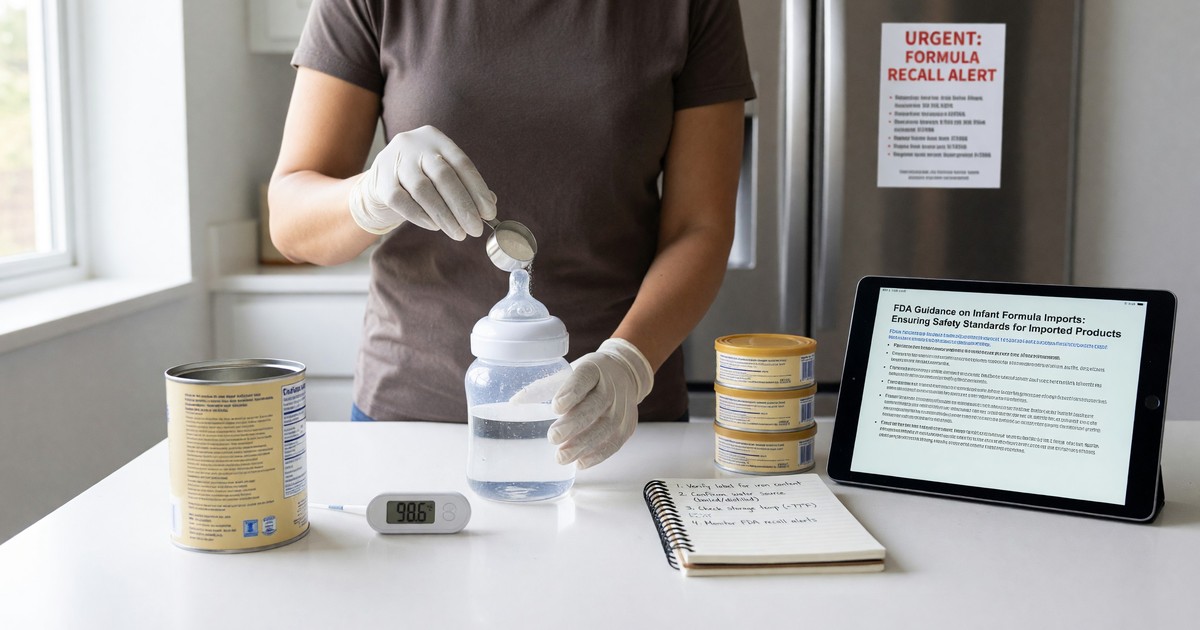
When formula became difficult to find during the 2022 shortage, a significant number of parents turned to homemade alternatives, foreign imports through informal channels, and diluted formula to stretch supply. All three of those approaches carry real risks — in some cases, serious ones. The shortage exposed a gap in how formula safety information reaches parents, and what the actual rules are for preparation and storage.
Infant formula is a regulated food product in the United States. The FDA’s infant formula regulations establish minimum nutrient requirements, manufacturing standards, and labeling requirements for formula sold in the U.S. That regulatory framework protects infants from products that do not meet nutritional standards — but it only applies to products covered by the framework. Understanding what falls inside and outside of it is part of using formula safely.
Types of infant formula
Powdered formula is the most common, most economical type. It is not sterile — it is heat-treated but not commercially sterilized — which matters for very young infants, premature infants, and immunocompromised infants. For these groups, the AAP and FDA recommend using ready-to-feed or concentrated liquid formula, which are sterile, or taking steps to reduce bacterial risk when using powder.
Concentrated liquid formula is sterile and requires mixing with water. It is more expensive than powder and has a shorter shelf life once opened.
Ready-to-feed formula is sterile, requires no mixing, and is the safest option for very young and high-risk infants. It is also the most expensive per ounce.
Specialty formulas — hypoallergenic, extensively hydrolyzed, amino acid-based, low-lactose, and soy-based — exist for specific medical indications. A switch to specialty formula should be made in consultation with a pediatrician, not based on consumer marketing claims. Parents who are also breastfeeding or transitioning between breast and formula should see our breastfeeding basics guide for context on when supplementation is appropriate. Most common infant GI symptoms (gas, fussiness, spitting up) are not signs of a formula allergy and do not require specialty formula.
Water safety for mixing
The water used to mix powdered or concentrated formula matters.
Tap water in most U.S. communities is safe to use after bringing to a boil for one minute (then cooling to feeding temperature) for very young infants, or using directly from the tap for older, healthy infants in municipalities with reliable water quality. The CDC’s guidance on water for formula preparation recommends checking with your local water utility on fluoride and lead levels — lead in older plumbing can affect tap water quality even when the utility’s source water is clean.
Well water should be tested before using for formula. It is not regulated by EPA’s public water standards, and contamination with nitrates, bacteria, and other compounds can be serious in infants.
Bottled water is not required, but parents who choose it should use low-fluoride options for formula mixing if the pediatrician recommends limiting supplemental fluoride.
Boiling: If boiling water before mixing, cool to lukewarm (approximately body temperature) before adding formula. Formula mixed with boiling water can destroy heat-sensitive nutrients. The right sequence is: boil, cool, mix.
How to prepare powdered formula safely
The two organisms of concern in powdered formula are Cronobacter sakazakii (formerly Enterobacter sakazakii) and Salmonella. Both can cause severe illness in infants under 2 months, premature infants, and immunocompromised infants. Both are killed by water heated above 70°C (158°F).
For high-risk infants (premature, under 3 months, immunocompromised), the CDC and WHO recommend using water that has been boiled and cooled to no lower than 70°C (about 5–10 minutes off the boil) for mixing. This kills any bacteria that may be present in the powder. The WHO’s guidance, “How to Prepare Formula for Bottle-Feeding at Home,” is the most rigorous available and is consistent with FDA and CDC guidance.
For healthy older infants with no additional risk factors, standard tap water preparation without boiling is generally acceptable.
Storage rules
Prepared formula (already mixed): refrigerate immediately and use within 24 hours. Discard any formula left in a bottle after a feeding — bacteria from the baby’s mouth multiply rapidly in warm milk.
Opened concentrate or ready-to-feed formula: refrigerate and use within 48 hours of opening. Discard after 48 hours regardless of how much remains.
Powdered formula: once opened, use within one month (not the date on the lid — the date from opening). Store in a cool, dry place with the lid tightly closed. Do not refrigerate powdered formula — the moisture introduces contamination risk.
Prepared formula at room temperature: safe for up to 2 hours. After two hours at room temperature, discard.
Formula recalls: how to check
Formula recalls happen. The mechanism for finding out whether a formula your infant is currently using has been recalled:
- FDA recall database: fda.gov/safety/recalls-market-withdrawals-safety-alerts — searchable by product type, date, or brand.
- USDA and FDA email/text recall alerts: both agencies offer free subscription alerts for food recalls. Sign up at fda.gov/safety/fdas-recall-firm-press-releases for FDA notifications.
- Your pediatrician’s office: practices that serve a large infant population typically track recalls. Ask your pediatrician’s office whether they send recall alerts to families.
If your formula is recalled: stop using it, check the FDA guidance for whether to discard or return, and contact the manufacturer or retailer for a refund. Contact your pediatrician about transitioning to an alternative.
What the 2022 shortage taught us about imports and alternatives
The 2022 Similac, Alimentum, and EleCare recall — tied to Cronobacter contamination at an Abbott Nutrition manufacturing facility — removed a significant share of U.S. formula supply from the market simultaneously. Many parents turned to European formula brands, often purchased through informal import channels.
European infant formula is regulated by the European Food Safety Authority (EFSA), and EU standards are generally comparable to U.S. FDA standards in nutrition composition. However, importing formula through informal channels — third-party resellers, gray market importers, auction sites — carries risks: products may be counterfeit, mislabeled, improperly stored during shipping, or past expiration date. The FDA explicitly cautions against purchasing formula through these channels. If a shortage requires supplement with a foreign brand, purchasing from a licensed, reputable importer is significantly safer than informal channels.
Homemade formula is never safe for infants. No homemade recipe meets the nutritional profile required for infant feeding, and the risk of under-nutrition and contamination is real. This is not a judgment about parenting choices — it is a fact about infant nutritional needs and food safety.
Choosing formula: what the label actually tells you
U.S. infant formulas are required by law to contain a specified minimum amount of each essential nutrient. The nutrient differences between name-brand and store-brand (generic) formulas meeting the same FDA standards are not clinically significant. Store-brand formulas are equivalent in composition and are substantially less expensive. The AAP’s position is that store-brand formulas meeting FDA standards are appropriate for healthy term infants.
DHA/ARA additions: Most U.S. formulas now add DHA (docosahexaenoic acid) and ARA (arachidonic acid), fatty acids found in breastmilk. The evidence for benefit from formula-added DHA is modest and mixed; it is not a reason to pay significantly more for one formula over another.
“Gentle,” “sensitive,” and “comfort” formulas: These marketing categories are not regulated definitions. Products marketed this way typically have partially hydrolyzed protein or reduced lactose — modifications that have not been demonstrated to reduce gas, fussiness, or colic in infants without a diagnosed sensitivity. Discuss formula changes for GI symptoms with your pediatrician before switching.
Frequently Asked Questions
Can I switch formula brands? Yes. For healthy term infants, switching between formula brands meeting FDA standards is safe. Introduce changes gradually if your infant shows sensitivity, but brand switching does not require a transition period in most cases.
Can I use well water for formula? Well water must be tested before using it for formula preparation. Well water is not regulated by EPA public water standards and can contain nitrates, bacteria, and other contaminants at unsafe levels for infants. Contact your county health department about low-cost or free well water testing.
How do I know if a formula has been recalled? Check the FDA’s recall database at fda.gov and sign up for FDA email alerts. If you are unsure whether a specific lot number is affected, the manufacturer’s customer service line can verify recall status from the lot number and date code printed on the can.
Is making my own formula at home safe? No. Homemade formula cannot meet the precise nutritional requirements for infant feeding and carries contamination risk. If cost is a barrier to formula access, contact your local WIC office — the WIC program provides formula for eligible infants at no cost, and WIC-approved formulas cover most major brands.
Does it matter what water I use for mixing? Yes. Municipal tap water is generally safe after verifying local lead and fluoride levels with your utility. Well water must be tested. For infants under 3 months or premature infants, use water boiled and cooled to at least 70°C for mixing to eliminate any bacterial risk in the powder itself.
What temperature should formula be served at? Most infants accept formula at room temperature or body temperature. Warming is a preference, not a requirement — formula does not need to be warmed. If warming, use a bottle warmer or warm water bath rather than a microwave; microwave heating creates hot spots that can burn an infant’s mouth.
Further Reading from Authoritative Sources
- FDA Infant Formula Guidance and Regulations — The FDA’s complete guidance on formula composition, manufacturing requirements, and recall information.
- CDC How to Prepare and Store Powdered Infant Formula — Step-by-step guidance on safe formula preparation and storage, including water safety and high-risk infant considerations.