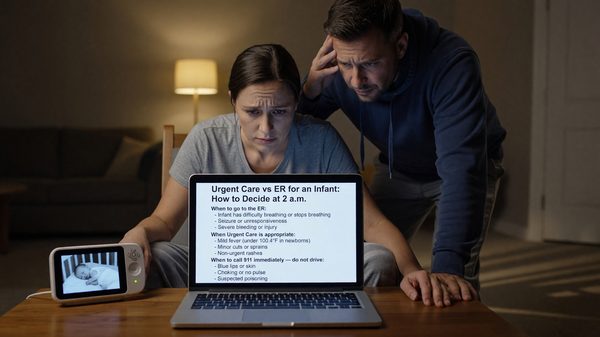
It is 11 p.m. The thermometer says 101.2°F. The baby is 8 weeks old. You are trying to remember what the pediatrician said about fever at the last visit and coming up mostly blank. Is this an ER trip? A call to the nurse line? A wait-and-see?
Fever is one of the most common reasons parents seek emergency care for infants — and one of the most misunderstood. The number on the thermometer is not the whole story. The age of the baby matters enormously. The baby’s overall appearance matters. How the temperature was measured matters. This guide is the framework for making that call — built on the same thresholds the American Academy of Pediatrics and the CDC use.
One important note first: this is educational information, not a substitute for your pediatrician’s judgment about your specific child. If your instinct says something is wrong, trust it and call or go in. The framework here is for the situations where the instinct is genuinely uncertain.
What fever actually is
A fever is defined as a rectal temperature of 100.4°F (38°C) or higher. Anything below that threshold is not a fever, technically — it may be a normal temperature fluctuation, or it may be “low-grade warmth,” but it is not the medical threshold.
Fever is a symptom, not a disease. It is the body’s immune response to infection — a signal that the system is working, not a sign that something has gone catastrophically wrong. The fever itself is rarely dangerous; what the pediatrician is evaluating is the cause of the fever, and whether the cause requires treatment.
There are a few exceptions where high fever can be directly harmful: very prolonged fever in very young infants who cannot compensate, and the rare febrile seizure in older infants and toddlers. But the fever number itself — 101°F, 102°F, 103°F — does not tell you how sick the child is. An infant who has a 104°F fever and is alert, interacting, and drinking is in a very different category from a 101°F infant who is limp and not responding to stimulation.
How to measure temperature correctly
Method matters — particularly for young infants.
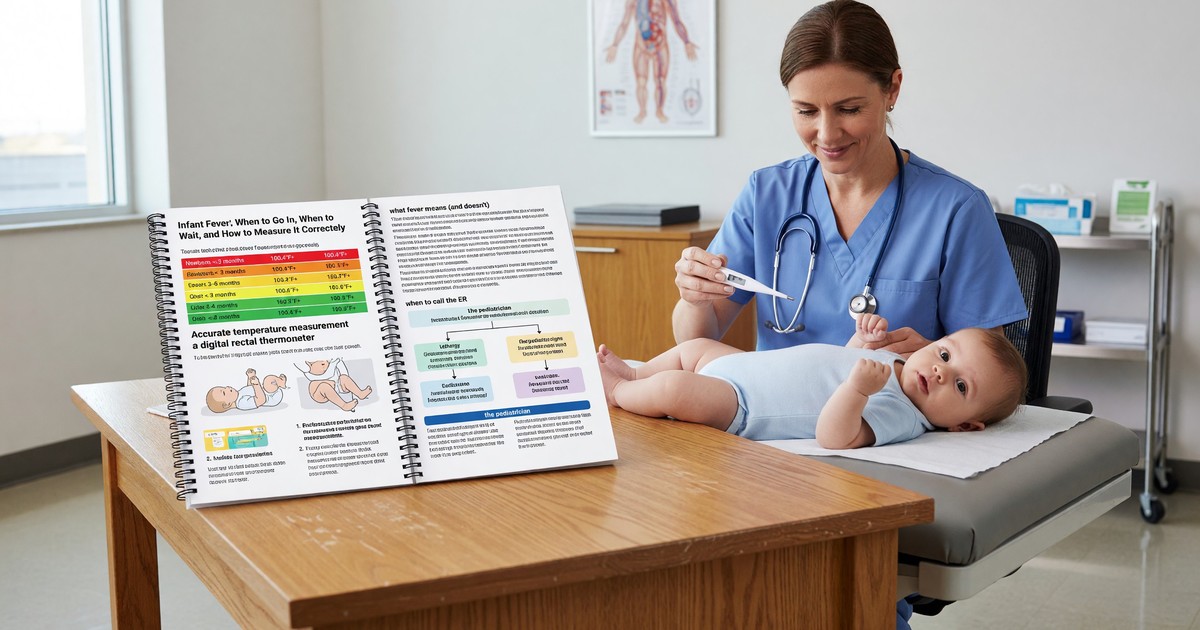
Rectal temperature is the most accurate method for infants under 3 months and is the gold standard for any clinical decision-making. To take a rectal temperature: lubricate the tip of a digital thermometer with petroleum jelly, lay the baby on their back with knees bent, gently insert the tip about half an inch to an inch into the rectum, and hold until the thermometer beeps. A normal rectal temperature is 97°F to 100.3°F (36.1°C to 37.9°C).
Axillary (armpit) temperature runs approximately 0.5–1°F lower than rectal temperature. An axillary reading is useful as a screening tool but is not accurate enough for decisions about a young infant’s fever. If the axillary reading is at or near 100°F, take a rectal temperature to confirm.
Forehead (temporal artery) thermometers are convenient but have more variability in infants, particularly when the infant has just been bundled up or is sweating. They are reasonable for screening and for older children; for young infants under 3 months, confirm with a rectal reading if a forehead reading raises concern.
Ear (tympanic) thermometers are not reliable in infants under 6 months — the ear canal is too small and curved for accurate readings.
For all methods: take the temperature before bundling or unbundling, and before or at least 30 minutes after a fever reducer to assess the true fever level.
The age-based thresholds
Age is the single most important factor in how seriously to treat a fever in an infant.
Under 3 months: always go in
Any fever (rectal temperature of 100.4°F or above) in an infant under 3 months requires evaluation in the emergency department — same day, promptly, without waiting for a call back. This is not negotiable guidance.
Here is why: a young infant’s immune system cannot mount the same response as an older child’s. Bacterial infections in this age group — group B strep, E. coli, Listeria, and others — can progress rapidly, and the physical exam cannot reliably distinguish them from viral infections. The standard evaluation for a febrile infant under 28 days typically includes bloodwork, urine analysis, and often a lumbar puncture (spinal tap) to rule out bacterial meningitis. This sounds alarming, but it is the correct standard of care, and the vast majority of these evaluations result in a viral illness diagnosis and a healthy discharge.
Between 28 and 90 days (1 to 3 months), current AAP guidelines on fever allow for some risk stratification — infants who appear well, have a low-risk bloodwork profile, and have a reliable caregiver may be able to be observed without a spinal tap, at the physician’s judgment. But this is a clinical decision made in person, not a reason to wait at home.
3 to 6 months
Fever above 102°F (38.9°C) in this age group warrants a same-day call to the pediatrician and likely an in-person evaluation. Fever below 102°F in an otherwise well-appearing, interactive, feeding infant can typically be monitored at home with a nurse line call.
Over 6 months
The thresholds become less strict, and the overall appearance of the child matters more than the number. Useful evaluation points:
- Fever above 104°F (40°C): Call the pediatrician. This level of fever warrants assessment, though it is rarely dangerous on its own if the child is otherwise alert and drinking.
- Any fever lasting more than 5 days: Call the pediatrician, regardless of the temperature level. Persistent fever warrants investigation.
- Fever with a rash that does not blanch: Go to the ER. A petechial or purpuric rash with fever can signal bacterial sepsis — meningococcemia in particular — which is time-sensitive.
- Fever with stiff neck, severe headache, or marked sensitivity to light: ER immediately — these are signs of meningitis.
- Fever with difficulty breathing, severe abdominal pain, or extreme lethargy: ER.
For the specific infections that most commonly cause fever in the first year — RSV, ear infections, and gastroenteritis — see our common infant illnesses guide, which covers what each illness looks like and when it warrants a visit. For the acute first-aid scenario of a baby with a very high fever or febrile seizure, our infant first aid essentials covers what to do while waiting for help.
Fever reducers: dosing and timing
Acetaminophen (Tylenol) is safe for infants 2 months and older. The dose is based on the infant’s weight, not age. The standard dose is 10–15 mg per kilogram of the infant’s weight, every 4–6 hours as needed, not exceeding 5 doses in 24 hours.
Ibuprofen (Motrin, Advil) is safe for infants 6 months and older only. Not for use before 6 months. Dose by weight as well.
Aspirin: Never for children or infants — risk of Reye’s syndrome.
For accurate dosing, confirm the correct dose for your infant’s current weight with your pediatrician at each well visit — infant weights change rapidly. The pediatrician’s office can give you a weight-based dose chart, or the nurse line can confirm it over the phone. The package label’s age-range chart is a rough guide but not as precise as weight-based dosing.
The goal of fever reducers is comfort — reducing the discomfort and improving the infant’s ability to drink. Treating a fever aggressively to reach a normal temperature is not the clinical goal; a child who is comfortable and drinking at 101°F does not necessarily need medication.
Alternating acetaminophen and ibuprofen is a technique sometimes used for high, persistent fever in older infants — giving each on a staggered schedule to maintain more continuous coverage. This approach is not first-line and should only be done with pediatrician guidance.
When NOT to go in
Part of the utility of a framework is knowing when the situation is genuinely manageable at home. A fever that warrants observation (not an ER trip) in an infant 3 months and older:
- The child is alert, interactive, and making eye contact
- The child is drinking fluids and producing wet diapers
- The temperature is below 104°F
- There is a clear likely cause (the baby just had a vaccine, or an older sibling has the same cold)
- The fever has been present for fewer than 5 days
- The pediatrician’s nurse line is available and has been consulted
Fever reducers that are working — the child is more comfortable and more interactive after the medication kicks in — are a reassuring sign. A child who is maximally dosed on fever reducers and is still not waking up or drinking is a concerning sign.
Febrile seizures: what parents need to know
Febrile seizures affect 2–5% of children, most commonly between 6 months and 5 years of age. A simple febrile seizure — a generalized convulsion lasting less than 15 minutes that stops on its own and is followed by normal behavior — is not associated with brain damage, epilepsy, or developmental problems in otherwise healthy children. They are frightening to witness, but they are generally not dangerous.
What to do during a febrile seizure: position the child on their side to prevent choking, move dangerous objects away, do not put anything in the child’s mouth, and time the seizure. After it stops, call the pediatrician or go to the ER for evaluation — even if the child seems fine afterward. The first febrile seizure always requires evaluation. A seizure lasting more than 5 minutes is a 911 call — it may need medication to stop it.
Preventing febrile seizures by aggressive fever treatment does not have strong evidence behind it. Febrile seizures are triggered by the rapid rise in temperature rather than the absolute level — which is why they often happen at the onset of illness before a parent knows the child has a fever.
Frequently Asked Questions
My 10-week-old has a rectal temperature of 100.7°F. Is this an ER trip? Yes. Any rectal temperature of 100.4°F or above in an infant under 3 months requires emergency evaluation — same-day, without waiting for a callback. This is not because the fever is certainly serious; it is because the clinical tools to distinguish serious from non-serious bacterial infection in this age group require in-person evaluation and bloodwork.
The forehead thermometer says 99.5°F but my baby feels really hot. What do I do? Take a rectal temperature to confirm. Forehead thermometers have variability, and erring on the side of accuracy for a young infant is appropriate. If the rectal temperature is 100.4°F or above in an infant under 3 months, go to the ER.
My baby had a febrile seizure and then seemed fine. Do I still need to go in? Yes. A first febrile seizure always requires evaluation, even if the child appears fully recovered. The emergency department will confirm it was a febrile seizure and not another type of seizure, check the cause of the fever, and counsel you on what to expect if it happens again.
Can fever cause brain damage? Fever alone — the body temperature elevation caused by infection — does not cause brain damage at the levels typically seen with infections in otherwise healthy children. Temperatures above approximately 107°F (41.7°C), sustained, can cause cellular damage — but this level is almost never reached with infection-related fever. Heatstroke (overheating from external sources) is a different situation.
Should I alternate Tylenol and Motrin for fever? Alternating acetaminophen and ibuprofen can be effective for comfort in high or persistent fever in infants over 6 months, but it should only be done under pediatrician guidance. The dosing schedule is easy to confuse, and double-dosing either medication is a real risk when two products are being used simultaneously.
Further Reading from Authoritative Sources
- CDC Fever in Children — Parent Information — Federal guidance for parents on recognizing fever, measuring temperature, and when to seek care.
- AAP Fever and Your Child — HealthyChildren.org — The American Academy of Pediatrics’ comprehensive parent-facing guidance on fever management, dosing, and the age-based thresholds for emergency evaluation.