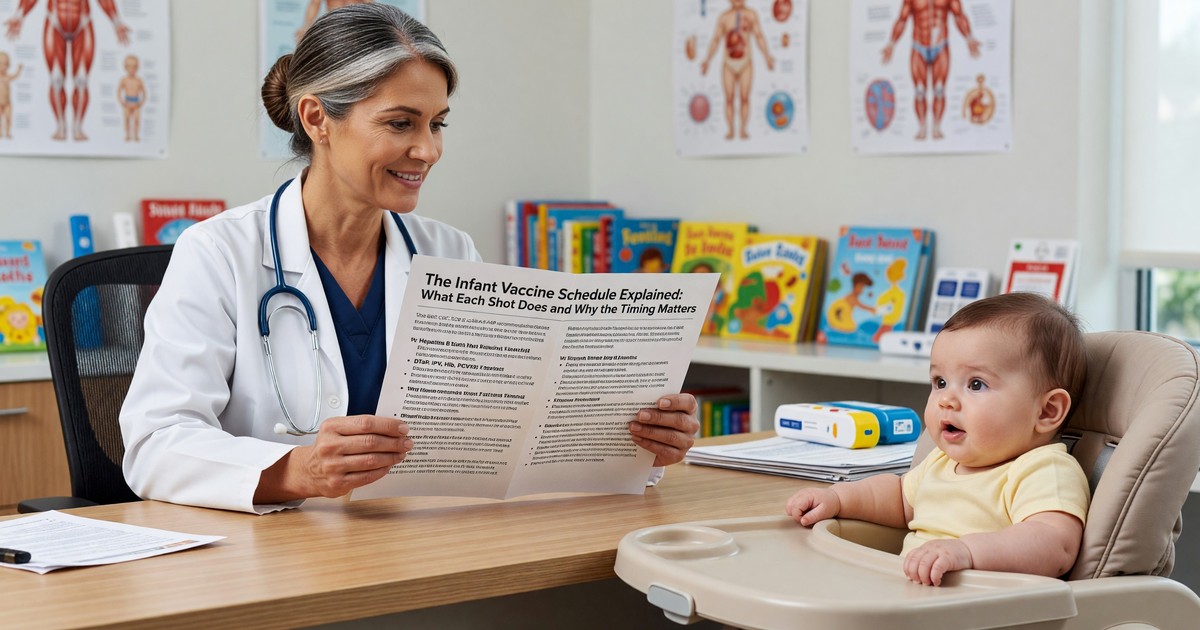
The pediatrician hands you the printout of vaccines your baby will receive today. There are four of them. Your baby is 2 months old and weighs 11 pounds. You are wondering why there are four, whether they are all necessary, and what the rest of the year looks like. You are not alone — this is one of the most common sets of questions in pediatrics.
This guide walks through the standard vaccine schedule for the first year, what each vaccine protects against, why the timing is not arbitrary, and what to expect afterward. It does not argue for or against vaccination as a choice — that is a conversation between you and your pediatrician, and the evidence base for the schedule is well established. The goal here is to give you the information to understand what is happening and why, so the decision is informed rather than based on a printout you did not have time to read in the exam room.
Why the schedule is what it is
The CDC’s childhood immunization schedule is developed annually by the Advisory Committee on Immunization Practices (ACIP), a committee of independent medical and public health experts. The AAP and the American Academy of Family Physicians co-endorse the schedule. It is not developed by vaccine manufacturers.
Two principles drive the timing:
Immunological windows. Different vaccines work differently in the immune system, and the immune system’s response changes with age. Some vaccines require the immune system to have reached a certain maturity to generate protective immunity; others must be given before the window of highest risk closes. Hepatitis B is given at birth because newborns exposed at delivery are at high risk of chronic infection if not immunized immediately. Rotavirus is given before 6–8 months because the most severe disease occurs in that window.
Protection when it matters most. The schedule is designed to provide immunity as early as possible for diseases where infants are most vulnerable. Pertussis (whooping cough), for example, is most deadly in infants under 3 months — before the first dose can even be given. That is why Tdap vaccination in pregnant parents is also recommended, to provide maternal antibodies across the placenta.
Spreading vaccines out or delaying them — sometimes proposed as “alternative schedules” — has been studied and does not offer safety advantages. It does leave infants unprotected during the windows of highest risk.
The first-year schedule: vaccine by vaccine
Birth: Hepatitis B (HepB), dose 1
Hepatitis B is a viral infection of the liver transmitted through blood and certain bodily fluids. In infants, it is most commonly transmitted from a mother with chronic hepatitis B infection during delivery. Without vaccination, about 90% of infants infected at birth develop chronic hepatitis B, which significantly increases lifetime risk of cirrhosis and liver cancer.
The first dose is given within 24 hours of birth. If the mother is hepatitis B surface antigen positive, the baby also receives hepatitis B immune globulin (HBIG) within 12 hours of birth.
2 months: DTaP, IPV, PCV15 or PCV20, Hib, RV (5 vaccines, sometimes as combination shots)
This is the appointment that looks alarming on paper. Five vaccines in one visit. In practice, many of these are available as combination shots (DTaP-IPV-HepB as Pediarix, for example) that reduce the number of injections to 2–3.
DTaP (diphtheria, tetanus, and pertussis): Pertussis — whooping cough — can be fatal in infants under 3 months. When infants do contract illness between vaccine doses, our common infant illnesses guide covers the signs that distinguish a mild viral illness from something requiring prompt evaluation. The coughing fits are severe enough to cause rib fractures and can deprive infants of oxygen. Before vaccination, diphtheria and tetanus were leading causes of childhood death. DTaP is one of the most important vaccines in the first-year schedule.
IPV (inactivated poliovirus vaccine): Polio is effectively eliminated from the Western Hemisphere through vaccination. Maintaining high vaccination rates is what keeps it that way. Unvaccinated communities have experienced imported outbreaks as recently as 2022 in the United States.
PCV (pneumococcal conjugate vaccine, either PCV15 or PCV20): Protects against Streptococcus pneumoniae, the most common cause of bacterial meningitis and a leading cause of ear infections and pneumonia in young children. Before PCV introduction, pneumococcal meningitis was a leading cause of childhood deafness and death.
Hib (Haemophilus influenzae type b): Before Hib vaccination, H. influenzae type b was the leading cause of bacterial meningitis in children under 5. Meningitis from this organism was a leading cause of childhood death and permanent disability. Hib is now rare in vaccinated populations.
RV (rotavirus): An oral vaccine, not an injection. Rotavirus causes severe vomiting and diarrhea in infants; before vaccination, it was responsible for approximately 55,000–70,000 hospitalizations of children per year in the United States. The oral vaccine series must be started before 15 weeks of age and completed before 8 months — the timing restriction is more rigid than for injected vaccines.
2 months: Hepatitis B, dose 2
The second HepB dose is given between 1 and 2 months.
4 months: DTaP, IPV, PCV, Hib, RV — second doses
Second doses of the vaccines started at 2 months. The immune system responds more robustly to a second exposure than the first — this is the basis of the multi-dose schedule.
6 months: DTaP, IPV, PCV, Hib, RV — third doses; HepB dose 3; Influenza (annual)
Influenza vaccination begins at 6 months of age. Infants and children under 5 are among the highest-risk groups for severe influenza illness and hospitalization. The first year of influenza vaccination requires two doses given 4 weeks apart; in subsequent years, one annual dose.
Hepatitis B, dose 3, is given between 6 and 18 months (most commonly at the 6-month visit).
12 months: MMR, Varicella, PCV, Hib, HepA
MMR (measles, mumps, rubella): MMR cannot be given before 12 months because maternal antibodies passed in pregnancy interfere with the vaccine’s effectiveness in the first year. Measles is highly contagious and was a leading cause of childhood blindness and death before vaccination. It causes encephalitis (brain inflammation) in roughly 1 in 1,000 cases. Measles outbreaks occur regularly in communities with low vaccination rates.
Varicella (chickenpox): Prior to vaccination, virtually every child got chickenpox. The disease is typically mild but causes significant missed work for parents, can cause serious bacterial skin infections, and carries a small risk of encephalitis. The vaccine also prevents shingles (caused by the same virus remaining dormant) later in life.
HepA (hepatitis A): Two doses beginning at 12 months, given 6 months apart. Hepatitis A is transmitted through contaminated food and water; vaccination prevents acute liver disease and reduces community transmission.
What to expect after vaccines
At the injection site: Redness, swelling, and tenderness at the injection site are common and normal — the immune system is responding. A firm lump (local granuloma) sometimes develops at the site of certain vaccines and can last weeks. It is not dangerous. Applying a cool cloth to the site helps with discomfort.
Fever: A low-grade fever (under 101.5°F) in the 24 hours after vaccination is common and normal — a sign of immune response. High fever (above 103°F) after vaccines is uncommon and warrants a call to the pediatrician.
Fussiness and sleepiness: Very common on vaccine day. Most infants are back to their baseline within 24–48 hours.
Dosing acetaminophen: The AAP no longer recommends preemptive dosing of acetaminophen before vaccines — there is evidence that prophylactic dosing may slightly blunt the immune response. Acetaminophen after vaccination, if the baby is uncomfortable, is appropriate.
When to call the pediatrician: High fever (above 103°F), inconsolable crying lasting more than 3 hours, unusual limpness or decreased responsiveness, or a rash beyond the injection site — these warrant a call. True serious reactions to vaccines are extremely rare; anaphylaxis, for example, occurs at a rate of approximately 1 per million doses, and pediatric offices are equipped to manage it.
Combination vaccines: reducing injection count
The FDA approves several combination vaccines that cover multiple diseases in a single injection, reducing the total number of shots per visit. Common combination vaccines in the first-year schedule:
- Pediarix: DTaP + IPV + HepB (three vaccines in one shot)
- Pentacel: DTaP + IPV + Hib (three vaccines in one shot)
- Vaxelis: DTaP + IPV + Hib + HepB (four in one)
Which combination is available depends on your pediatrician’s office supply. Ask at the visit which combination formulations are being used — it can significantly reduce the number of injections your baby receives.
Catching up on missed vaccines
If a dose is missed — because of an illness on the scheduled day, an insurance gap, or any other reason — it can be made up. The CDC’s catch-up schedule (cdc.gov/vaccines/schedules) provides specific guidance on minimum intervals between catch-up doses. Restarting a series from the beginning is almost never necessary — caught-up doses count toward the total.
Frequently Asked Questions
Why do babies need so many vaccines at the 2-month visit? The 2-month visit has the most vaccines because that is when the window of highest vulnerability for several serious diseases opens, and because immunity needs to be established early. The diseases the 2-month vaccines prevent — pertussis, bacterial meningitis, polio — are most dangerous in infants and young children. Delaying spreads out the shots but leaves the infant unprotected during the highest-risk windows.
Are combination vaccines as effective as individual vaccines? Yes. FDA-approved combination vaccines are tested for equivalency to individual vaccines before approval. They produce the same immune response and the same protection; their advantage is reducing injection count.
My baby is sick. Should we skip vaccines today? Minor illness — a mild cold, low-grade fever — is not a reason to postpone vaccines. The immune system can respond to vaccines during minor illness. The reason to reschedule is if the baby is acutely unwell with significant fever or a moderate-to-severe illness that might make it harder to assess whether a post-vaccine reaction is from the vaccine or the underlying illness.
Is it true some vaccines contain mercury or aluminum? Thimerosal (a mercury-containing preservative) was removed from all routine childhood vaccines except some multi-dose influenza formulations by 2001. Single-dose influenza vials are thimerosal-free. Aluminum salts are used as adjuvants (compounds that enhance immune response) in some vaccines; the amount per dose is small relative to the aluminum infants receive from breastmilk and formula, and no association with harm has been established at these levels.
What if I want to follow an alternative vaccine schedule? Many pediatricians will work with families who have questions about the schedule, though most will not recommend a significantly delayed or alternative schedule — because the alternative schedule leaves infants unprotected during windows when the diseases are most dangerous. Discuss your specific concerns with your pediatrician. If you feel your concerns are not being taken seriously, that is a legitimate reason to seek a second opinion.
Where can I find the full current vaccine schedule? The CDC’s current childhood immunization schedule is updated annually and is the authoritative source. The schedule is also available in parent-friendly format at HealthyChildren.org.
Further Reading from Authoritative Sources
- CDC Childhood Immunization Schedule — The current CDC-recommended schedule for children from birth through 18 years, updated annually with ACIP guidance.
- AAP Vaccine Information — HealthyChildren.org — The American Academy of Pediatrics’ parent-facing immunization information, including what each vaccine protects against and how to prepare for vaccine visits.