The guidance on when and how to start solids has changed more than once in the past twenty years, and the version most parents received from their own parents — “give cereal at 4 months,” “wait on allergens until after 1 year” — is not what the evidence supports now. Understanding why the recommendations changed, and what the current guidance actually says, makes it easier to navigate the noise of opinions from every direction.
The short version: around 6 months, with some flexibility for readiness signs, is the current standard. The old rule about waiting on common allergens has been reversed for most children. And rice cereal as a first food has no special status — it is just one option among many, and not the best-evidenced one.
When to start: reading readiness signs
The American Academy of Pediatrics and the CDC’s infant nutrition guidance both point to “around 6 months” as the typical starting point — not 4 months, which was the older guidance, and not 6 months as a strict rule regardless of the baby’s development. The key word is readiness.
Signs that suggest readiness for solids:
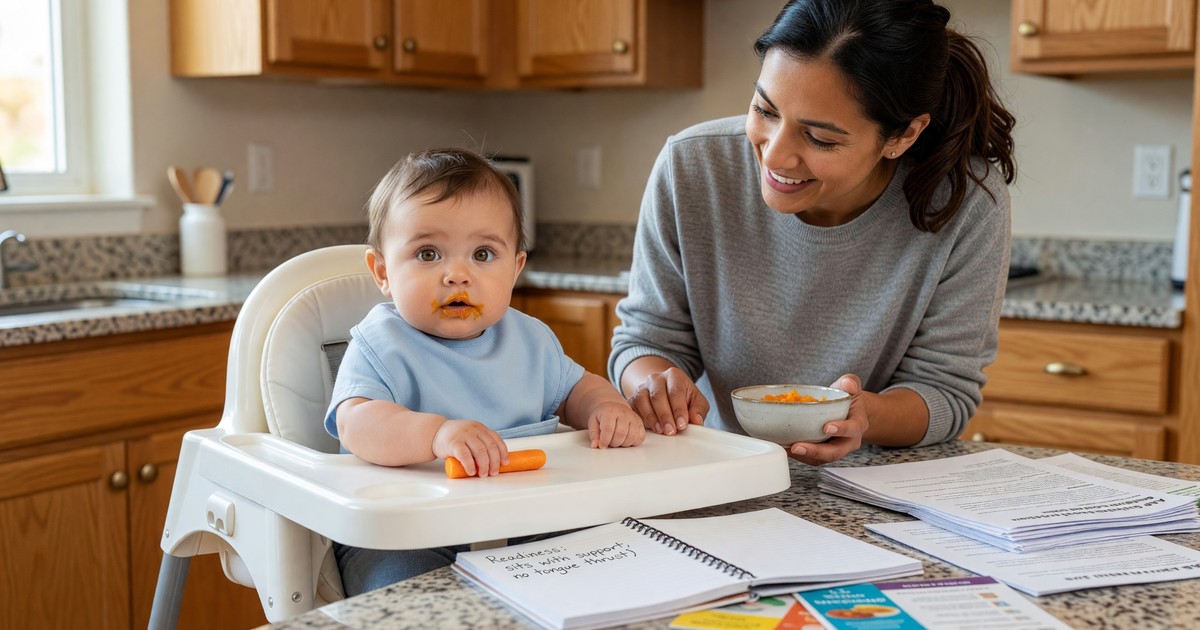
- Sitting with minimal support and holding the head steady. An infant who slumps forward or cannot hold their head up does not yet have the postural control to manage solid food safely.
- Loss of the extrusion reflex. Young infants automatically push food out of their mouth with their tongue (the extrusion reflex). When this reflex fades, usually around 4–6 months, the baby can actually move food to the back of the mouth and swallow it.
- Showing interest in food. Watching caregivers eat, reaching for food, opening the mouth when food approaches.
- Doubled birth weight (roughly) — a general indication of sufficient physical development.
A child who is 6 months old but does not meet these signs is not ready. A child who meets these signs at 5 months can discuss starting with their pediatrician — the window is 4–6 months in terms of physiological capability, with 6 months as the typical target. Starting before 4 months is not recommended; the gut is not developmentally ready.
What to start with
There is no required first food. The old convention of iron-fortified rice cereal as a starting food has a logic (iron is important; breastfed babies in particular need additional iron from around 6 months), but rice cereal has two downsides: it is a refined grain with low nutritional density, and the FDA has raised concerns about arsenic levels in rice products, particularly for frequent consumption in infants.
Better first food approaches:
Iron-rich foods first. Iron-fortified pureed meats, lentils, beans, and iron-fortified cereals (oat, multi-grain, or barley rather than exclusively rice) help address the iron gap that develops around 6 months. Breastfed babies are born with iron stores that are largely depleted by 4–6 months; iron in breastmilk is highly absorbable but present in limited amounts.
Vegetables and fruits early. There is no strong evidence that introducing vegetables before fruits prevents a later preference for sweet foods — babies already strongly prefer sweet tastes from birth. However, offering a variety of flavors and textures early (during the “flavor window” roughly between 6 and 12 months) does appear to increase acceptance of a wider range of foods later.
Texture variety. Purees are one approach. Baby-led weaning (offering soft finger foods from the start rather than purees) is another. The evidence on outcomes between these approaches is mixed — no clear advantage in developmental outcomes or long-term eating patterns — but combination approaches that include both are common and well-tolerated.
Allergen introduction: the guidance has reversed
The previous guidance — wait until after age 1 (or even age 3 for peanuts) to introduce common allergens — has been substantially reversed based on evidence from the LEAP trial (Learning Early About Peanut Allergy) and subsequent studies.
The current guidance from the NIH’s National Institute of Allergy and Infectious Diseases and the AAP:
- Peanuts: For infants with mild to moderate eczema or existing egg allergy, early introduction of peanut-containing foods between 4 and 6 months is recommended — preferably after evaluation by an allergist or pediatrician. For severe eczema or known egg allergy, evaluation before introduction is strongly recommended. For infants with no eczema or food allergy, early introduction (around 6 months with solids) is recommended without prior testing.
- Tree nuts, shellfish, wheat, soy, fish, eggs: The AAP no longer recommends delaying these beyond the typical solid-food introduction period for most infants. Introduction around 6 months, alongside other foods, is the current standard.
The practical implication: introducing a variety of common allergens early — around 6 months, in age-appropriate forms — reduces, rather than increases, the risk of food allergy development. This is the opposite of the older guidance.
When introducing a new food with allergy potential, offer a small amount of the single food while the family is home for 1–2 hours. If a reaction occurs (hives, vomiting, difficulty breathing, behavioral change within minutes to 2 hours), call the pediatrician or go to the ER depending on severity. Introduce one new food at a time and wait 3–5 days before introducing another new high-allergen food — not because this prevents allergy, but because it makes identifying a specific trigger easier if a reaction occurs.
Foods to avoid in the first year
Honey: Never before 12 months. Honey can contain Clostridium botulinum spores that cause infant botulism — a serious and potentially fatal illness in infants whose gut cannot handle the spores the way older children and adults can.
Cow’s milk as a drink: Not as a main drink before 12 months. Dairy products in food (cheese, yogurt, baked goods containing milk) are fine from the start of solids. It is the large volume of cow’s milk as a drink that is problematic — it can cause iron-deficiency anemia by displacing iron-rich foods and causing microscopic gut bleeding in some infants.
High-sodium processed foods: Infant kidneys cannot handle the sodium load of adult processed foods. Season infant food with herbs and spices if desired; avoid adding salt.
Choking hazard foods: Whole grapes, whole cherry tomatoes, chunks of raw carrot, whole nuts, round candies, chunks of meat — any food that is firm, round, and the approximate diameter of an infant’s airway. The AAP’s choking hazard list is comprehensive. Cut round foods in quarters; cut long foods into strips rather than rounds; ensure meat is soft and shredded.
Added sugar and fruit juice: The AAP recommends no fruit juice before 12 months and no added sugars in the first year. Juice in infants contributes to dental caries and displaces nutrients from solid foods without providing meaningful nutritional benefit.
Rice as a sole grain, frequently: Given FDA concerns about arsenic in rice products, vary grains. Oats, barley, and quinoa are appropriate alternatives.
How much is enough?
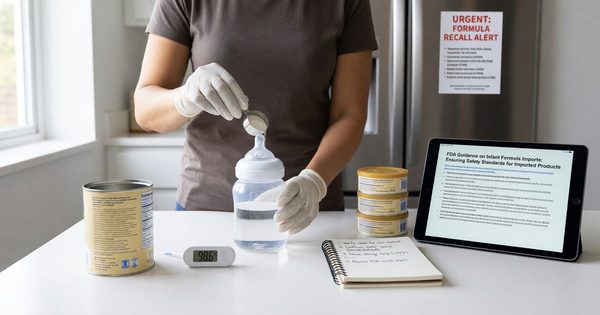
Quantity expectations for infants starting solids are small. A few spoonfuls at the first sitting is appropriate and expected. By 8–9 months, most infants are eating 2–3 meals per day with some snacks, but breastmilk or formula remains the primary nutrition source through at least 12 months. For parents managing breastfeeding alongside solids, our breastfeeding basics guide covers the continued-nursing evidence and how supply changes as solids increase. For formula questions, see formula safety and preparation. Food before 12 months is partly nutrition and partly practice — practicing the skills of chewing, swallowing, and managing textures.
Watch for hunger cues (reaching for food, opening mouth, leaning forward) and fullness cues (turning away, closing mouth, pushing food away). Feeding to a schedule rather than to the infant’s hunger and fullness cues is associated with poorer self-regulation of intake — the infant feeding literature consistently supports responsive feeding.
Frequently Asked Questions
Can I start solids at 4 months? The AAP currently recommends starting solids around 6 months, citing risks of early introduction including increased risk of obesity and insufficient gut development. Starting before 4 months is not recommended for any reason. Some infants show readiness between 4 and 6 months — discuss with your pediatrician if your infant seems ready before 6 months.
What is baby-led weaning and is it safe? Baby-led weaning (BLW) means offering soft, appropriately-sized finger foods from the start of solids rather than pureed foods. Studies suggest BLW is safe when parents are informed about appropriate food sizes and textures, and that it may improve self-regulation and reduce pickiness long-term — though the evidence is not conclusive. The choking risk with BLW is not higher than with pureed feeding when foods are appropriately prepared.
My baby rejected every food we tried. Is that normal? Yes — refusal is normal, and repeated exposure is the most evidence-based response. Research suggests that children may need to be exposed to a new food 10–15 times before accepting it. Refusal is not a signal to stop offering. Offer, let the child handle or explore the food without pressure, and try again another day.
When should my baby drink water? Small amounts of water (a few ounces per day) can be offered with solid meals once solids are introduced, typically around 6 months. Before 6 months, infants do not need water — breastmilk and formula contain all the fluid they need, and excess water in a young infant can dilute electrolytes dangerously.
Is it safe to give babies eggs? Yes — eggs can be introduced around 6 months as part of typical allergen introduction. Cook eggs fully (scrambled, hard-boiled) to eliminate the risk of Salmonella. Eggs are a nutritionally dense first food and are specifically part of the updated early allergen introduction guidance.
Further Reading from Authoritative Sources
- CDC Starting Solid Foods Guidance — The CDC’s current guidance on timing, readiness signs, first foods, and foods to avoid in the first year.
- NIH NIAID Peanut Allergy Prevention Guidelines — The National Institutes of Health guidance on the LEAP trial findings and updated recommendations for early peanut introduction in high-risk infants.