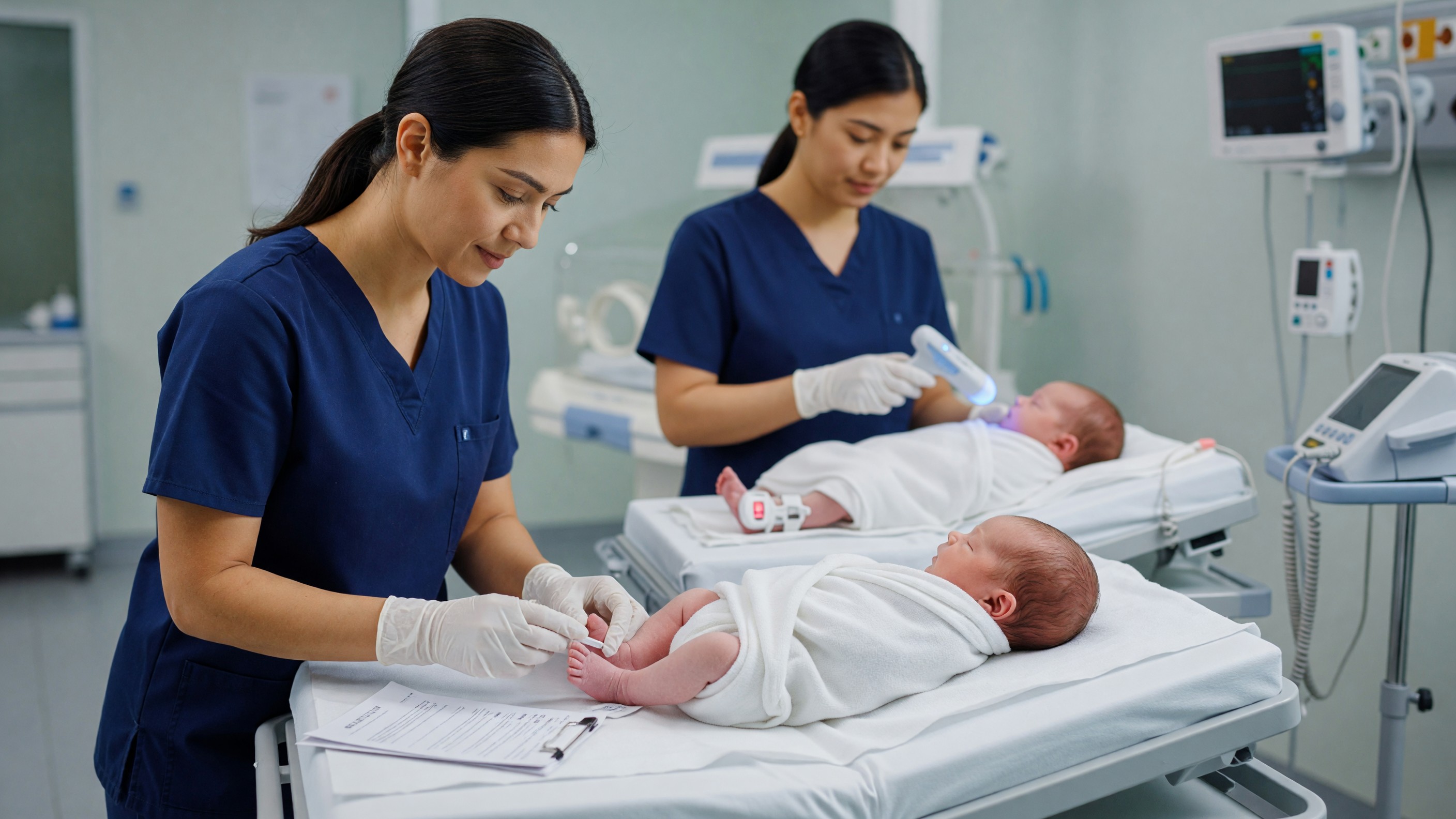
Somewhere in the first 24 to 48 hours after your baby is born, a nurse will come in with a small lancet, a card with white circles on it, and a tiny machine that wraps around your baby’s foot or hand. The whole process takes a few minutes. You will probably be told “we screen every baby for some conditions” and asked to sign a form. And then it is done, and you forget it ever happened.
That short procedure is one of the most important pieces of preventive medicine your child will ever receive. Most parents have no idea what was actually screened for, what would happen if a result came back abnormal, or what to do in the rare case that one does. This is a plain-English walk-through of the system — what gets tested, who decides which conditions to screen for, what “positive” actually means, and the follow-up timeline that gets missed more often than it should.
The three categories of newborn screening
In the United States, every newborn — regardless of where they are born, what insurance the family has, or what state they are in — is screened in three ways before discharge:
- Blood spot screening — a few drops of blood from a heel prick, collected on a card and sent to a state lab.
- Hearing screening — a small device tests whether the baby’s auditory system is responding normally to sound.
- Pulse oximetry (CCHD) screening — a sensor measures the oxygen saturation in the blood to look for critical congenital heart disease.
All three are non-invasive (well — the heel prick is minimally invasive), all three are quick, and all three are covered without out-of-pocket cost in nearly every birth setting. The CDC’s newborn screening portal is the federal hub for parent information on what each screen covers and why.
The Recommended Uniform Screening Panel (RUSP)
The Recommended Uniform Screening Panel, almost always referred to as the RUSP, is the federal list of conditions recommended for newborn screening in the United States. It is maintained by the Secretary of Health and Human Services with input from the Advisory Committee on Heritable Disorders in Newborns and Children, and it is published by the Health Resources and Services Administration.
The RUSP is a recommendation, not a mandate. States decide which conditions on the panel they actually screen for, which is why screening varies — sometimes significantly — from state to state. We will come back to state variation in a minute.
The RUSP is updated periodically as new evidence emerges. Conditions can be added when there is enough scientific consensus that early identification, before symptoms appear, meaningfully changes outcomes. A condition has to meet several criteria: there has to be a test that can identify it reliably in newborns, there has to be a treatment or intervention, and the intervention has to be more effective if started early.
You can read the current panel directly at HRSA’s website. There are currently several dozen “core conditions” plus a number of “secondary conditions” that often appear on the same test results.
What blood spot screening tests for
Blood spot screening is sometimes called the “PKU test” by parents and grandparents, because phenylketonuria (PKU) was the first condition added to the panel in the 1960s. The name stuck even though modern screening tests for many more conditions than just PKU.
The categories of conditions screened for in the blood spot include:
- Metabolic disorders — conditions where the body cannot properly break down certain foods, building up substances that cause harm. PKU is the classic example. Many of these conditions are managed by adjusting the diet, sometimes dramatically, starting in the first weeks of life.
- Endocrine disorders — most importantly congenital hypothyroidism, where the thyroid does not produce enough hormone. Without early treatment, this causes serious developmental delays. With early treatment (a daily hormone replacement pill), affected children develop normally.
- Hemoglobinopathies — including sickle cell disease and other inherited blood disorders.
- Lysosomal storage disorders — a group of rare conditions where the body cannot break down certain substances at the cellular level.
- Other rare conditions — including severe combined immunodeficiency (SCID, sometimes called “bubble boy disease”), cystic fibrosis (though confirmation requires additional testing), and several others depending on the state.
We are intentionally not listing every condition by name. The RUSP currently includes several dozen core conditions, the list changes over time, and your state’s specific panel may add or omit some of them. The authoritative current list is maintained at the HRSA RUSP page, and your state’s exact panel is maintained by your state department of health.
For a high-level explanation of what blood spot screening looks for and why, the March of Dimes newborn screening overview is parent-friendly and accurate.
What happens if a screen comes back positive
This is the part of the newborn screening conversation that most parents are not prepared for, and the part where the most damage is done by misinformation.
A “positive” or “out of range” newborn screening result does not mean your baby has the condition. It means the screening number fell outside the normal range, and follow-up testing is needed to determine whether the condition is actually present. The vast majority of positive screens are false positives — the follow-up testing comes back normal and the child is fine.
False positives happen for many reasons: the blood spot was collected too early, the baby was premature, the baby was on certain medications, the lab equipment had a slightly off run, or the baby simply has a normal variant that triggered the screening threshold. These are not “mistakes.” The screening tests are intentionally calibrated to err on the side of catching every true positive, even at the cost of generating some false positives, because missing a real case is far worse than a few weeks of parental anxiety while confirmatory testing is done.
If you receive a call about a positive newborn screen:
- Do not panic. Easier said than done. But the most likely outcome is normal confirmatory testing.
- Find out exactly which condition is being screened in. Write the name down. Ask for the spelling.
- Schedule the confirmatory testing immediately. Your pediatrician or a specialist (often a metabolic geneticist, endocrinologist, or hematologist depending on the condition) will arrange this. Do not delay even by a few days.
- Ask what would change about the baby’s care between now and the confirmatory result. For some conditions, a precautionary dietary or other intervention is started until confirmation comes back. For others, no immediate change is needed.
- Get the confirmatory result in writing, whatever it shows.
The American Academy of Pediatrics newborn screening guidance consistently emphasizes the same point: the most important thing the screening system does is generate fast, clear communication between the lab, the pediatrician, and the family. If you feel like you are not getting clear communication, escalate — ask the pediatrician for the state newborn screening program’s contact information, and call them directly. They are usually accessible.
State variation — yes, it really does vary
Because each state decides which RUSP conditions to screen for, the number of conditions tested varies by state — sometimes by a meaningful amount. A state that screens for 35 conditions and a state that screens for 60 are both providing real value, but they are not providing the same value.
The Newborn Screening Technical Assistance and Evaluation Program (NewSTEPs) maintains a state-by-state directory of which conditions each state’s program screens for. HRSA also publishes state profiles. These are the authoritative sources.
A few practical implications:
- If you move between states during pregnancy or in the first year of life, your child may have been screened for a different set of conditions depending on where they were born.
- If you give birth in one state and live in another, the screening lab is generally the state of birth.
- Most state programs publish their full condition list on the state department of health website. It is usually called something like “Newborn Screening Program” or “Newborn Bloodspot Screening.”
- If your state does not screen for a condition that you have a family history of, you can sometimes request supplemental testing through your pediatrician at your own (or your insurance’s) expense.
Hearing screening — auditory brainstem response and OAE
Newborn hearing screening uses one of two methods (sometimes both):
- Otoacoustic emissions (OAE) — a soft probe is placed in the baby’s ear and emits a sound. A normally functioning inner ear produces a faint echo in response, which the device detects. Quick, painless, and usually done while the baby is sleeping.
- Auditory brainstem response (ABR) — soft electrodes are placed on the baby’s head, sounds are played through small earphones, and the device measures the brain’s electrical response to the sound. Also painless, also usually done while sleeping.
If the screen does not pass on the first try, it is repeated. A repeat that also does not pass is referred for diagnostic testing — usually a more detailed ABR with an audiologist. Like blood spot screening, a “did not pass” result on the initial screen does not mean your baby has hearing loss. Fluid in the ear canal from the birth itself, a noisy room during the test, or the baby being unsettled can all cause non-passing results that resolve on the repeat.
If hearing loss is confirmed, early intervention matters enormously. The federal Early Hearing Detection and Intervention (EHDI) program at the CDC sets the framework: ideally, hearing is screened by 1 month of age, diagnosed by 3 months, and intervention started by 6 months. This is sometimes called the “1-3-6” benchmark. The earlier intervention starts, the better the long-term language outcomes.
Pulse oximetry — CCHD screening
The third screen, pulse oximetry, looks for critical congenital heart disease (CCHD) — a group of serious heart defects that can be life-threatening if not identified early. A sensor placed on the baby’s right hand and one foot measures the oxygen saturation in the blood. Low or unequal readings can indicate a heart defect that is not yet causing visible symptoms.
This screen was added to the RUSP relatively recently (in the 2010s) after evidence showed it could identify cases of CCHD that would otherwise be missed and that early identification meant earlier surgery and significantly better outcomes. The CDC’s CCHD screening page has parent-friendly information about what the screen looks for and why it matters.
Like the other screens, a positive pulse oximetry result triggers diagnostic testing — usually an echocardiogram (an ultrasound of the heart). Many positive screens turn out to be normal hearts; some identify defects that need monitoring, medication, or surgery.
Out-of-hospital births — how to get screening
If your baby is born at home, at a birth center, or in any setting outside a hospital, you are still entitled to newborn screening, and most states require it. Your options:
- The midwife or birth attendant may have the blood spot collection card and the trained skill to collect it. They send it to the state lab the same way a hospital would.
- If not, you can take the baby to your pediatrician’s office, a public health clinic, or a hospital outpatient lab in the first few days of life to have the blood spot collected.
- Hearing screening is typically available at audiology offices and at most birthing centers; some pediatric practices have the equipment in-office, and many community programs offer free hearing screens.
- Pulse oximetry screening can be done at the pediatrician’s office or any clinic with a properly calibrated pediatric pulse oximeter, in the first 24–48 hours of life or as soon afterward as possible.
If you are planning an out-of-hospital birth, talk to your midwife and pediatrician about the screening plan before the birth so the logistics are arranged in advance. Do not assume it will happen automatically.
The follow-up timeline most parents miss
If the screens all come back normal, there is no formal follow-up beyond your regular well-child visits. You can request a copy of the results for your records — and you should, because that documentation matters down the road, especially if you ever change pediatricians or states.
If a screen is positive or inconclusive, here is the timeline that should happen — and that you should track personally, because the system does not always:
- Within days of the abnormal result: A call from the state program, the hospital, or your pediatrician. Sometimes more than one. Make sure your contact information is correct on the discharge paperwork, including a cell number that will pick up.
- Within 1–4 weeks: Confirmatory testing. The exact timing depends on the condition. For some conditions, it is immediate. For others, it is scheduled with a specialist.
- Within 1–3 months: A confirmed diagnosis (or a “negative — no condition present” result). If you have not received a definitive answer in this window, call.
- Ongoing: If a condition is confirmed, regular follow-up with a specialist becomes part of your child’s care plan. Make sure your pediatrician’s office has the specialist’s contact information and that records are flowing in both directions. If you ever need help coordinating, a hospital social worker is often a useful resource even after discharge.
For families whose newborns spent time in the NICU, some screens are done while the baby is still admitted, but others may be deferred or repeated after discharge depending on the baby’s condition. Confirm in writing with the NICU team which screens have been done and which are pending. In the days after discharge, safe sleep setup and car seat installation are the two other first-week safety priorities most families find themselves unprepared for.
Hospital records, including newborn screening results, are part of the documentation you should keep for the long term. If you ever need to retrieve them years later, the hospital is required to provide them under federal record-retention rules, though the process can be involved. Pulling and reviewing those records is the kind of thing covered at Healthcare Facility Guide, which has guides on how hospitals are required to maintain and release records.
FAQ
Does insurance cover newborn screening? Yes. Newborn screening is covered under preventive care provisions of the Affordable Care Act, and most state programs cover screening costs directly through state-administered programs regardless of insurance status. You should not receive a separate bill for the standard screening tests.
Can I refuse newborn screening? Most states allow parents to decline screening on religious or personal grounds, though the process varies. We would strongly discourage declining, because the conditions screened for can be devastating if missed and are very treatable if caught early. Talk to your pediatrician before making this decision.
My baby was screened in a different state from where we live. Do we need to repeat it? Generally no. The screening is valid regardless of where you live now. However, if you have a family history of a condition that your state of residence screens for but the state of birth did not, talk to your pediatrician about whether supplemental testing makes sense.
What if I lost the discharge paperwork with the screening results? The hospital where the baby was born retains the records and can provide a copy on request. Your state’s newborn screening program also keeps records and can provide them. Your pediatrician’s office often has a copy as well — they are sent the results when the baby is registered with the practice.
My baby’s screen was positive. Should I be worried? A positive screen is far more often a false positive than a confirmed diagnosis. The screening system is intentionally calibrated to catch every true case, which means it also catches some that turn out to be nothing. Follow the confirmatory testing plan promptly, do not panic, and ask for clear communication at every step. Resources like HealthyChildren.org and the Mayo Clinic patient guidance can help you understand what the confirmatory process looks like.
Is the heel prick painful for the baby? It is briefly uncomfortable — comparable to a small needle stick. Babies usually cry for a moment and settle within a minute. There is no evidence of lasting effects. Some parents find that feeding the baby during or immediately after the prick reduces the upset.