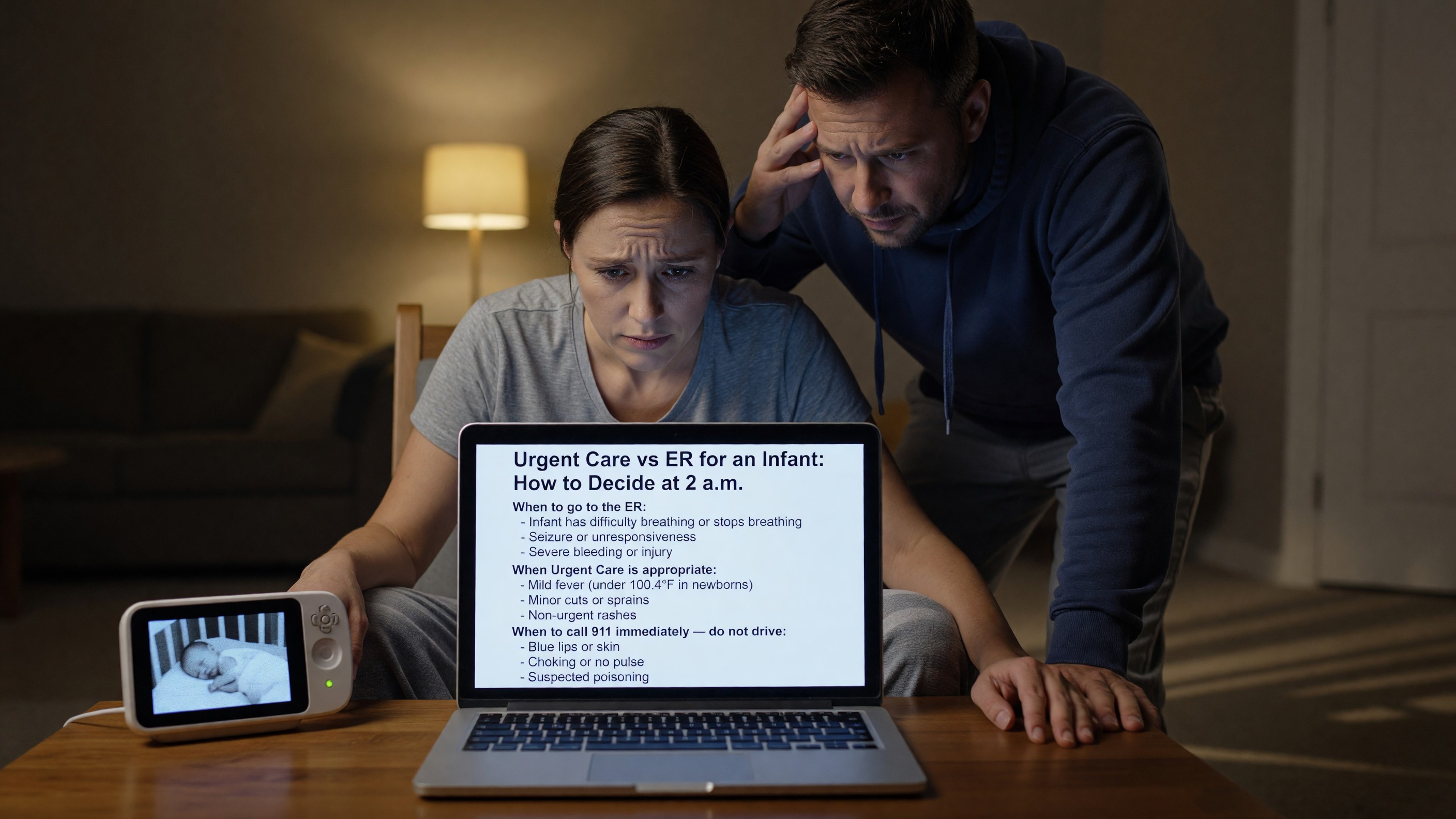
It is 2 a.m. The baby is hot. The baby is not acting right. You are standing in the kitchen in your pajamas trying to decide: is this an urgent care visit in the morning, the ER right now, or something I should call 911 about?
We have all stood in that kitchen. The instinct to “wait it out” and the instinct to “do something” both feel reasonable, and at 2 a.m. neither one is easy to trust. This article is the framework we wish we had — what we have learned to look for, when to stop deliberating and dial, and what the actual difference is between urgent care and the ER for a small child.
This is educational only. When you are not sure, call your pediatrician’s nurse line. If the line is closed or you cannot reach anyone and your gut is telling you something is wrong, err on the side of going.
The signs that mean 911 — no decision tree, just call
Some things skip the decision-making step entirely. If you are seeing any of these in an infant or young child, you call 911. You do not drive. Driving puts your child in a car seat, in the back, where you cannot watch them, in traffic, without a paramedic.
Call 911 for:
- Trouble breathing — visible struggling, blue or grey lips or skin, gasping, or pauses in breathing
- Unresponsiveness, or unusual difficulty waking the child
- A seizure (any duration, first time, or any seizure in an infant)
- Severe injury — falls from significant heights, head injuries with loss of consciousness or repeated vomiting, suspected broken bones, deep cuts that will not stop bleeding
- Choking that does not clear
- Suspected poisoning or ingestion of something dangerous (call Poison Control at 1-800-222-1222 simultaneously, but if the child is unresponsive or having trouble breathing, 911 first)
- Any condition where your honest read of the situation is “something is very wrong”
The AAP’s parent-facing symptom guidance at HealthyChildren.org is the source we go back to most often for “what does this symptom mean and how serious is it.” But none of these signs require you to look anything up. If you are seeing them, call.
The ER signs — go now, but you have time to put on shoes
There is a category of symptoms that means the emergency department, not urgent care, and not waiting for morning. You generally have time to grab shoes, a diaper bag, and your insurance card — but not time to wait until office hours.
ER-appropriate situations in an infant or young child include:
- Any fever in an infant under 3 months of age. The CDC’s guidance for parents on fever emphasizes that a young infant’s immune system is different, and fever in this age group requires medical evaluation rather than home monitoring.
- Dehydration signs — significantly fewer wet diapers than normal, no tears when crying, dry mouth, sunken soft spot, lethargy
- Persistent vomiting that prevents fluid intake, especially in young infants
- Vomit that contains green bile, or blood in vomit or stool
- A rash that does not blanch (does not turn white) when you press on it, particularly if accompanied by fever
- Significant breathing changes — fast breathing, wheezing, retractions (skin pulling in around the ribs or above the collarbone) — that improve some but worry you
- A head injury without loss of consciousness, but with persistent crying, repeated vomiting, or behavioral changes
- A burn that is large, deep, on the face, hands, feet, or genitals, or any burn on an infant
For age-specific symptom checklists, AAP’s HealthyChildren.org has printable guidance for parents organized by symptom and age.
The urgent care signs — but only at a pediatric urgent care
Urgent care can be the right choice for an older infant or child with:
- A mild ear infection picture (ear-pulling, mild fussiness, low-grade fever) in a child over 3 months
- A minor laceration that probably needs glue or a stitch or two, but is not actively bleeding hard
- A suspected mild sprain
- A rash that is not associated with fever or breathing problems
- Pink eye
- A cough or cold that is not improving but is not getting dramatically worse
- A urinary tract infection picture (painful urination, fever) in a verbal child
The critical caveat: most urgent care centers are designed for adults. The staff are competent — but they may not have pediatric-sized equipment, pediatric medication dosing protocols at their fingertips, or experience with infants. A pediatric urgent care is a different category, staffed by pediatricians or pediatric-experienced nurse practitioners, with child-sized equipment.
Before you ever need it, find out:
- Does your area have a pediatric urgent care?
- What are its hours?
- Does it accept your insurance?
If you do not have a pediatric urgent care nearby, the practical rule of thumb is: under one year old, a true emergency is the ER. An adult urgent care for a young infant is rarely the right answer.
Why a pediatric ER is different — when you have the choice
Many large hospitals have either a dedicated pediatric emergency department or a “kid-friendly” track within the main ER. If your area has a children’s hospital with a pediatric ED, that is generally where to go for a child’s emergency, even if it is slightly farther than the nearest adult ER.
Why it matters:
- The doctors and nurses see only pediatric patients. They are faster at noticing the signs that matter and more confident with the calls that are harder in kids.
- Pediatric-sized equipment is on hand — pediatric IVs, pediatric airway equipment, weight-based dosing systems.
- The environment is calmer and quieter, which actually changes the quality of evaluation, because a less-distressed child gives a more accurate exam.
- Imaging protocols are calibrated for pediatric radiation safety.
Hospital accreditation and credentialing — including the distinction between a hospital with general emergency services and one with pediatric-specific designation — is the kind of thing covered at Healthcare Facility Guide. It is worth checking, before an emergency, what level of pediatric emergency care your nearest hospitals are formally credentialed to provide.
If you do not have a pediatric ER nearby, the nearest ER is still the right choice for emergency situations. You do not skip an ER because it is not pediatric-specific.
Age-specific notes — the under-3-months rule
Newborns and young infants are a different category from older babies and toddlers. Their immune systems are immature, their ability to localize an infection is limited, and a serious illness can look like “just being fussy” until it suddenly does not.
The clearest rule, summarized by the AAP and the CDC, is that any fever in an infant under 3 months requires medical evaluation. For the specific temperature threshold and how it should be measured, see HealthyChildren.org’s fever and your baby guidance. That evaluation is generally a pediatric ER or, during business hours, a same-day pediatrician visit with the explicit understanding that it may end up at the ER.
For infants and children between 3 months and 3 years, fever alone is less of an emergency signal than how the child looks and behaves. A child with a high fever who is alert, responsive, drinking, and consoled by being held is generally a different situation from a child with a moderate fever who is limp, refusing fluids, and inconsolable.
For the specific temperature thresholds, how to measure correctly, and age-based rules on when to go in versus wait, see our infant fever guide — which also covers dosing acetaminophen correctly by weight rather than by age-range label.
What to bring — and what they will ask
When you go to the ER or urgent care with a child, bring:
- Insurance card and photo ID
- A list of current medications, including the names, doses, and last time given
- Allergies — to medications, food, latex, anything
- Vaccine record, especially if your child is not yet fully on schedule
- A list of any chronic conditions and the specialists who treat them
- The pediatrician’s name and phone number
- Snacks, a phone charger, and patience — ER wait times for non-life-threatening pediatric issues can be hours
They will ask:
- Onset — when did the symptoms start?
- Course — has it gotten worse, better, or stayed the same?
- Associated symptoms — fever, vomiting, diarrhea, rash, behavioral changes?
- Last fluid intake and last wet diaper
- Last dose of any medication you gave for fever or pain
- Any sick contacts, recent travel, recent procedures, or recent injuries
- Whether the child has had this same kind of illness before
Practice the answers in your head on the way. Adrenaline makes specifics hard to retrieve.
After the visit — paperwork, follow-up, billing
An ER or urgent care visit is the beginning of a paper trail, not the end. Before you leave:
- Get the discharge paperwork. It should include the diagnosis (or “diagnoses considered”), what was done, any prescriptions, return-to-clinic instructions, and red-flag symptoms that should bring you back.
- Confirm the follow-up plan. Is this a “call your pediatrician in 24 hours” situation, “come back to the ER if X happens,” or “no follow-up needed unless symptoms recur”? Ask explicitly.
- Ask what gets sent to your pediatrician. Most ERs will send a copy of the visit summary to the primary pediatrician, but it can take days, and sometimes it does not happen. Call your pediatrician’s office the next business day to confirm they received it, or bring your own copy.
- Take photos of any wounds, rashes, or visible changes. This helps with follow-up and with insurance.
On the billing side, ER visits and urgent care visits are billed very differently. Even an “uncomplicated” ER visit for a child with a non-emergency diagnosis can generate a bill in the thousands. If you receive bills you do not understand, our how to read a hospital bill walkthrough goes through the line items and what is negotiable.
If a hospital social worker was involved in the visit, they often remain a resource for follow-up questions about billing assistance, transportation to follow-up appointments, and connecting to community services.
When you are honestly not sure
Most parents underestimate how often even pediatricians and ER doctors say “I’m not sure — let’s get more information.” Not being sure is not a failure. The right next step when you are not sure is almost always a phone call: your pediatrician’s nurse line, the practice’s on-call line, or in a pinch, 911 dispatch, which will help you decide. Dispatchers are trained to triage and will not be annoyed.
The only wrong move is staring at the child for three hours hoping to feel more certain.
FAQ
Is it OK to drive to the ER, or should I call an ambulance? For situations on the 911 list above — trouble breathing, unresponsiveness, seizure, severe injury — call 911. An ambulance can begin care en route and gets prioritized at arrival. For ER-appropriate situations that are not immediately life-threatening, driving is reasonable if you have a second adult who can sit with the child in the back seat. Never drive alone with a critically ill child in a car seat in the back where you cannot see them.
Can I use telehealth or a virtual visit instead? For an older child with a clearly minor issue (mild rash, pink eye, a question about a known condition), telehealth can be appropriate. For an infant, for any breathing concern, for any fever in a young infant, or for any concerning symptom in a child who looks unwell, telehealth is not a substitute for in-person evaluation. Use your judgment based on whether the child can actually be evaluated by a doctor looking at a screen.
Why is my ER bill so much higher than the urgent care bill for the same problem? ERs are required by federal law (EMTALA) to provide stabilizing care regardless of ability to pay, and their billing reflects the cost of maintaining 24/7 emergency capability, specialized staff, and immediate access to advanced imaging and labs. Urgent care centers operate on a much lower cost base. Even when the medical issue turns out to be minor, an ER visit will generate a facility fee that urgent care does not.
What if my child improves on the way to the ER? Go anyway. Some illnesses — particularly in children — fluctuate. A child who looked worrying twenty minutes ago and looks fine now may still have something serious going on. The ER doctors would rather see a child who looks well in the moment than miss something that recurs at home.
Do urgent cares treat newborns? Most general urgent cares prefer not to treat infants under a certain age, often three months or six months. Pediatric urgent cares may have different policies. Call before you go — they will tell you their age cutoff over the phone, and if your child is below it, they will redirect you to the ER.
What if I cannot pay for the ER visit? Federal law requires hospitals to stabilize emergency patients regardless of insurance or ability to pay. Many hospitals also have financial assistance programs (sometimes called “charity care”) for patients below certain income thresholds. Ask the registration desk or a hospital social worker about applying. Our hospital bill walkthrough has more on the assistance-application process.