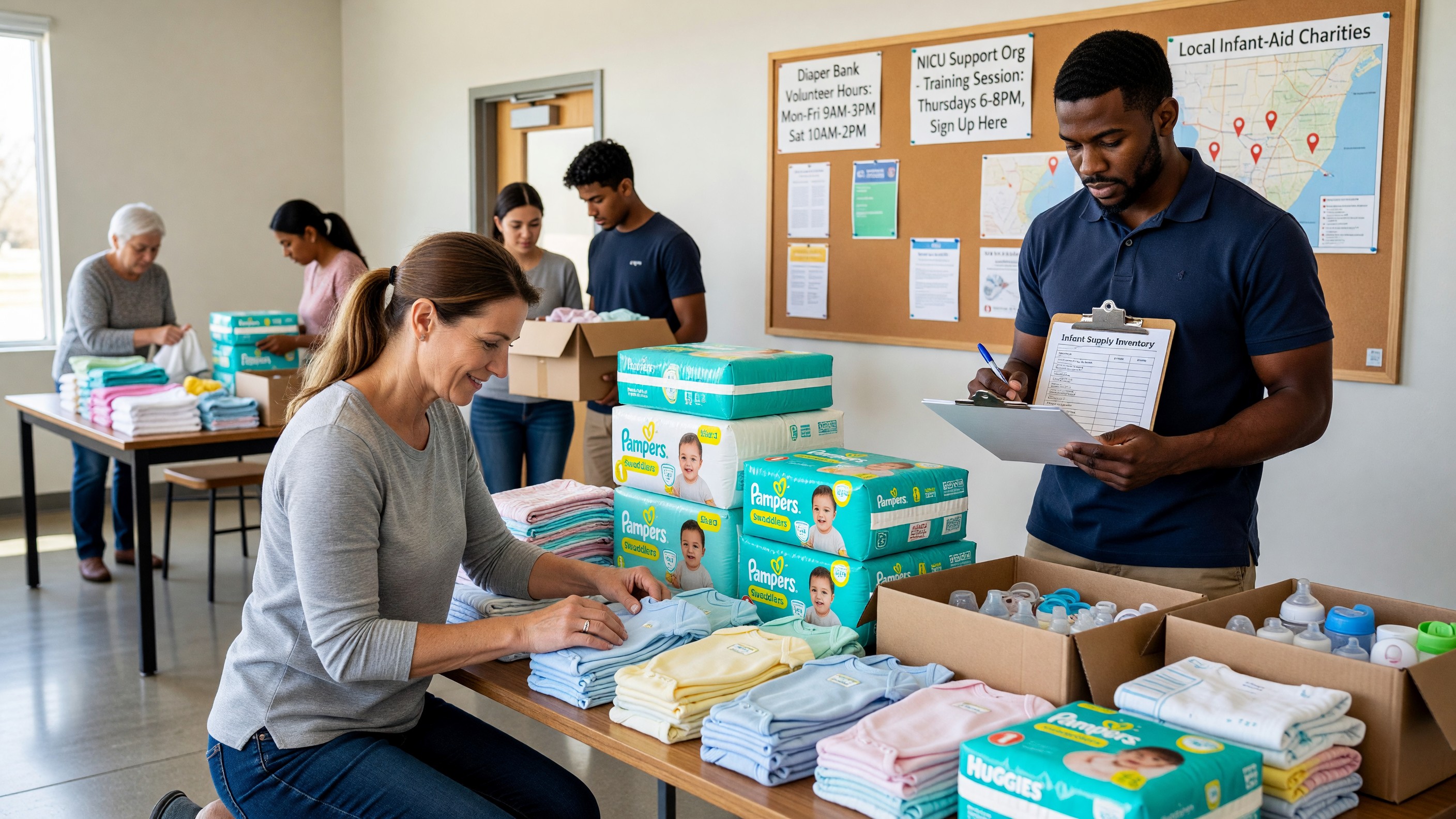
A lot of parents — especially the ones who came through a hard stretch themselves — eventually look around and want to give time back to the kind of organizations that help families with infants. Diaper banks. NICU family-support nonprofits. Hospital family rooms. Food pantries that stock formula. The Tulsa charity that originally used this domain was exactly that kind of organization.
This article is a practical guide for finding and choosing one to volunteer with, and what realistic time commitments look like. We are not affiliated with any of the organizations linked below; they’re examples and starting points.
What infant-aid charities actually need
The first surprise for new volunteers is usually that the help these organizations need is much more boring than what people expect. “Holding babies in the NICU” gets the photo coverage. “Sorting donated clothing by size” is what runs ten hours a week and keeps the doors open.
In rough order of how much volunteer time most organizations actually need:
- Sorting and packing donated items. Diaper banks, baby-clothing closets, and emergency baby-supply nonprofits run on volunteer labor to sort donations by size, condition, and category. This is steady work that mostly happens during business hours but increasingly on evening/weekend shifts to accommodate working parents.
- Picking up and delivering bulk donations. If you have a vehicle and a couple of hours on a weekend, this is one of the highest-leverage things you can do. Diaper drives donate pallets at a time.
- Sitting at intake tables. Most family-aid programs have intake — a parent comes in or calls, and someone has to take basic information, explain the program, and route them. This often requires a couple of consecutive hours, a quiet space, and some training (an hour or two).
- Helping with diaper drives. Most diaper banks run several annual donation drives. They need volunteers to staff drop-off locations, transport collected donations, and run sorting on the back end.
- Hospital family-room hosting. Hospitals with NICUs often have an attached “family room” where parents of babies in the unit can shower, sleep briefly, eat, and decompress. Most of these are staffed partly by volunteer hosts who keep the space clean and stocked.
- NICU rocking / cuddler programs. These exist but are typically harder to break into than people expect — they require extensive training (often 6–12 hours) plus a background check, and slots fill quickly.
Things volunteers often want to do but charities rarely need (or screen carefully for):
- Counseling, social work, or emotional support — these are professional services and require clinical credentials
- Anything involving medical advice or care — even informal
- Anything that involves giving money directly to families on the org’s behalf
- “Mentoring” programs without formal training
How to find a real, vetted charity to volunteer with
A handful of national directories are the safest starting points. They list 501(c)(3) organizations and include basic financial transparency information.
- The National Diaper Bank Network maintains a member directory of accredited diaper banks across all 50 states. The network is the largest single referral source for diaper-related volunteer needs in the U.S.
- Charity Navigator rates nonprofits on financial health and transparency. Search for “infant” or “diaper bank” plus your zip code. The site is free and the ratings are widely used.
- VolunteerMatch is the largest general-purpose volunteer-listing site; the “Children & Youth” and “Health & Medicine” categories surface the most family-aid opportunities.
For NICU-specific volunteering, your best starting point is the hospital itself. Most large hospitals have a volunteer services office; call or email and ask specifically about pediatric or NICU programs. The hospital’s social work department can usually point you to the right contact.
What time commitments actually look like
This is where most volunteer programs lose people. Expect:
- An onboarding step. Even simple sorting-room volunteering at a diaper bank usually requires an application, a brief interview, and a 1–2 hour orientation. NICU-adjacent programs require background checks (paid for by the hospital, but they take 2–6 weeks).
- A minimum commitment. Most family-aid nonprofits want you for at least 3 months, often 6, of regular shifts. This is because training has a real cost — they don’t want to train someone for a single shift.
- Shift length of 2–4 hours. A typical sorting-room shift runs 9 a.m. to noon or 1 p.m. to 4 p.m. Evening shifts (5–7 p.m.) and weekend shifts (Saturday mornings) tend to be in higher demand and lower supply.
- Realistic frequency of 1–2 shifts per month. Most programs accept this. If you can do weekly, you’ll be a star, but they don’t expect it.
A few special cases
Hospital-based volunteer programs
These are different from community charity volunteering. The vetting is stricter: background check (usually fingerprint-based, often costing the hospital $50–$100 per volunteer that they don’t recover), TB test, sometimes flu shot, sometimes a measles titer. Plan for 2–6 weeks between application and first shift. The trade-off is that hospital volunteers get access to programs (NICU family-room hosting, sibling support during ICU stays, etc.) that don’t exist anywhere else.
NICU cuddler / rocking programs
Highly sought after, very competitive, real waitlists in most regions. The training is significant — often 12+ hours, sometimes spread over multiple weeks — and the eligibility criteria are strict (no recent infectious illness, full vaccination, etc.). If you’re committed to this specifically, the best path is to call the volunteer services office at the hospital where you’d want to serve and ask about the application timeline. Some programs only open applications once a year.
Diaper drives at workplaces and faith communities
If you can organize a one-week diaper drive at your office, your child’s school, or a community organization, that’s often more impactful than any individual volunteer shift. A typical workplace diaper drive can collect 3,000–10,000 diapers in a week, which is one to three months of supply for several families through the recipient diaper bank. Drives are easy to set up — most diaper banks will provide collection bins, signage, and a one-page explainer.
What to ask before you commit
Treat the volunteer-coordinator interview as a two-way conversation. Reasonable questions to ask:
- What does the organization actually do day-to-day? (Their website can be aspirational; the daily reality matters.)
- What’s the minimum time commitment they ask for?
- What does training look like, and is it paid?
- What populations do they serve, and is there any chance of direct contact with families in crisis? (If yes, what’s the support structure for that?)
- How does the org handle volunteer feedback when something feels off?
- What’s their volunteer-retention rate? (Healthy orgs track this; if they have no idea, that’s a yellow flag.)
What you might get out of it
Most volunteers we’ve talked to mention some version of two things. First: pattern recognition. Sorting donations or staffing intake gives you a much clearer view of which programs work and which ones don’t, which is useful if you’re ever in a position to need them. Second: community. Volunteer-heavy nonprofits attract a lot of parents whose kids are slightly older than yours, which means you end up with a small, low-pressure network of people who’ve already navigated whatever you’re about to.
Neither of those is the reason to do it. The reason to do it is that these organizations need the help. The pattern recognition and community are happy side effects.
FAQ
Can I volunteer with my kids?
Some programs allow it (sorting rooms, certain community-aid programs). Most clinical or hospital-adjacent programs don’t because of background checks and confidentiality. Check with the organization.
Is there a tax benefit to volunteering time?
No — the IRS does not allow you to deduct the value of your volunteer time. You can deduct out-of-pocket expenses (mileage at the charitable rate, supplies you bought for the organization) if the recipient is a qualified 501(c)(3) and you itemize. Keep receipts.
How do I know an organization is legitimate?
Look it up on Charity Navigator or GuideStar (Candid). Both list a charity’s 501(c)(3) status, IRS Form 990 financials, and a basic transparency score. If an organization can’t be found on either, that’s worth a conversation before committing time.
Do I need any specific skills?
For sorting and event-staffing work, no. For intake or any client-facing role, you’ll typically be trained. For NICU or clinical-adjacent roles, the organization will tell you what they require, and the answer is almost always “show up trainable, we’ll handle the rest.”
What if I don’t have a few hours a month but want to help?
One-time bursts count. Organizing a diaper drive at your workplace, donating gently used baby clothes via your area’s family-aid network, or contributing financially to a vetted nonprofit are all higher-impact-per-hour than most volunteer shifts. For broader practical guidance on supporting families in crisis, see our piece on healthcare navigation for families.
Where do hospitals fit in if I want to volunteer specifically around infant care?
Start at the volunteer services office of the hospital nearest you. Larger hospital systems and academic medical centers — many of which are profiled on our sister site Healthcare Facility Guide — typically have the most developed volunteer programs and the most range of opportunities.